
Braided vs PVC Cable: Choosing the Right Jacket for Your Order
Two cables built on the same copper can feel nothing alike in the hand, and the jacket is almost always why. Buyers weighing braided against PVC want one answer: which construction survives the way this cable actually gets used. Braid buys abrasion resistance, grip and a softer drape. PVC buys lower unit cost, a smaller outer diameter and predictable tooling. Braid does not buy heat resistance, better shielding or longer life on its own, and plenty of change requests arrive with that assumption attached.
This guide covers what each jacket is, where each one really wins, and how the braided vs PVC cable decision moves tooling, artwork approval and repeat orders.
What each jacket is actually made of
A PVC cable is a conductor bundle with extruded polyvinyl chloride over it, produced in a single pass at a fixed outer diameter. The compound is formulated for flexibility, flame behaviour and surface finish, and the extrusion die sets the diameter everything downstream depends on.
A braided cable adds a woven textile sleeve over that same core, usually nylon or polyester, often over a second thin jacket. The braid is a sleeve. It is not insulation and it is not the flame barrier. Ask which layer carries the temperature or flame rating and the answer points to the compound underneath.
That fact settles most arguments in this category. A braided assembly is mechanically different from a PVC one and electrically the same, unless the buyer also changes stranding, shield coverage or gauge.
Where braided construction earns its cost
Braid solves mechanical problems well in four situations:
- Sliding abrasion. Cables dragged across stage floors or rolled under pedalboards wear on the outer surface first. A tight weave spreads that contact across many filaments instead of one smooth wall.
- Point loads. A truss clamp pinches a cable in one spot. Braid spreads the load around the circumference, which keeps the jacket from taking a permanent set.
- Grip and drape. Textile does not go slick when hands are damp and hangs with fewer kinks than a glossy extrusion.
- Surface appearance. A matte weave hides scuffs that show immediately on gloss PVC, which matters for rental fleets and product photos.
For a braided microphone cable, the construction and gauge make the difference checkable rather than a finish claim. The balanced braided XLR assembly is a useful reference build, and the microphone and XLR cable category covers the range.
Where PVC is the practical choice
PVC wins on what appears in a purchase order rather than a product photo:
- Unit cost. One extrusion pass, against an extrusion plus a braiding step, plus yarn, plus end finishing.
- Outer diameter. At the same conductor and shield, PVC gives the smaller finished diameter, which decides whether the cable fits a backshell, a grommet or a conduit.
- Cleanability. A shop rag with a mild solvent takes grease off PVC. Textile absorbs it and holds the stain.
- Marking. Length marks and part numbers print directly on PVC. On braid they need a sleeve or a printed band, which is a separate artwork approval.
For fixed installs, patch panels and OEM builds where the cable is never handled, PVC is usually the sound answer. The PVC XLR range exists for exactly that reason.
What the jacket does not change
Four properties stay where they were, whatever the outer layer looks like:
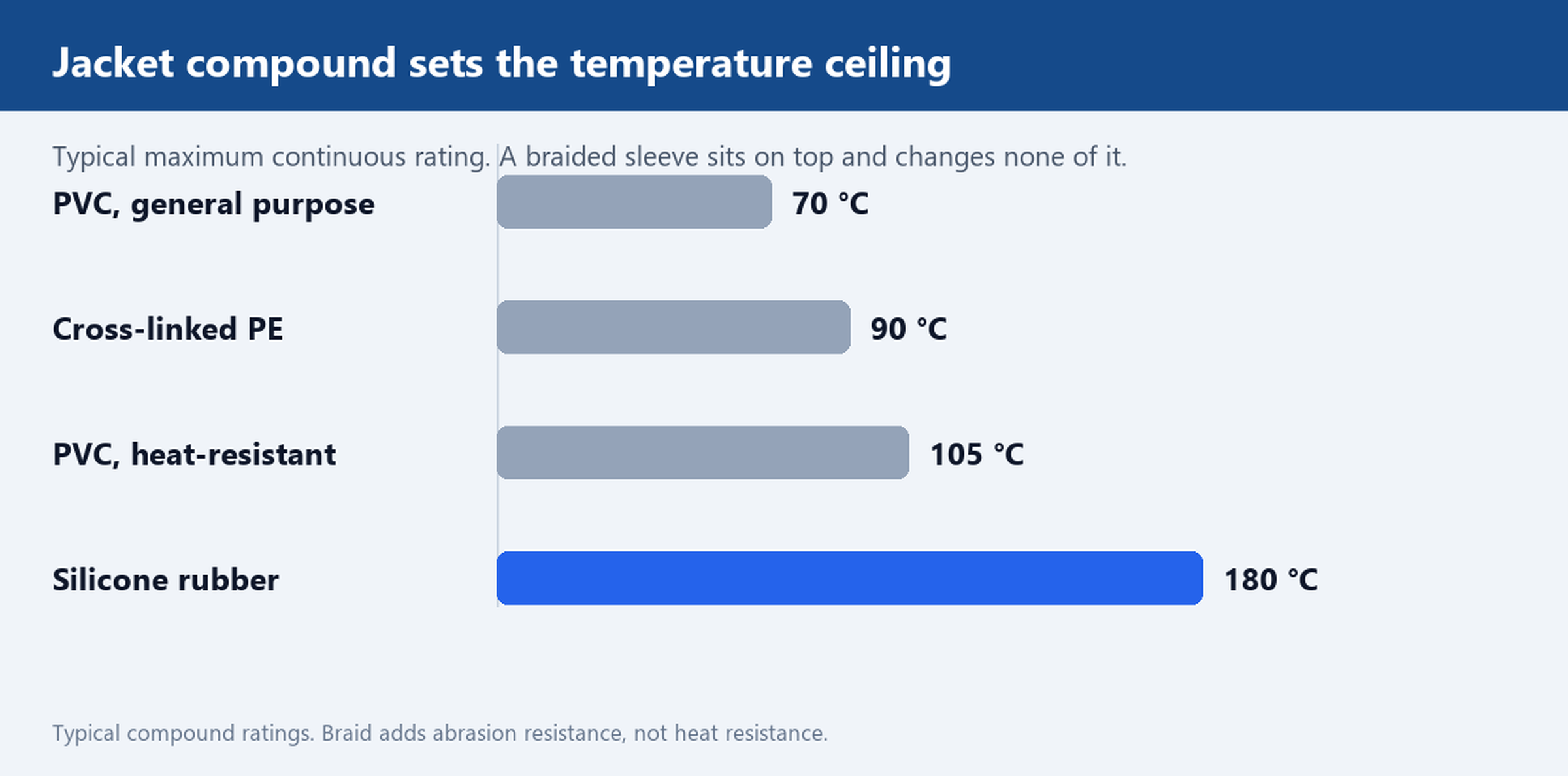
- Temperature ceiling. Set by the compound, not the weave. General-purpose PVC is commonly rated to 70 °C, heat-resistant grades to 105 °C, cross-linked polyethylene to 90 °C and silicone to 180 °C. Braid over a 70 °C core is still a 70 °C cable.
- Shielding. Foil, spiral or braided copper shield decisions sit under the jacket and decide interference performance. A textile sleeve does nothing for shielding.
- Conductor and gauge. Voltage drop, current capacity and flexibility all come from the copper and the stranding.
- Connector plating. Contact life and mating cycles are a connector decision.
If a project needs a higher temperature rating, the fix is a different compound, not a braid. That is the most common mis-buy here and the easiest to prevent with a two-line spec.
Matching the jacket to the use case
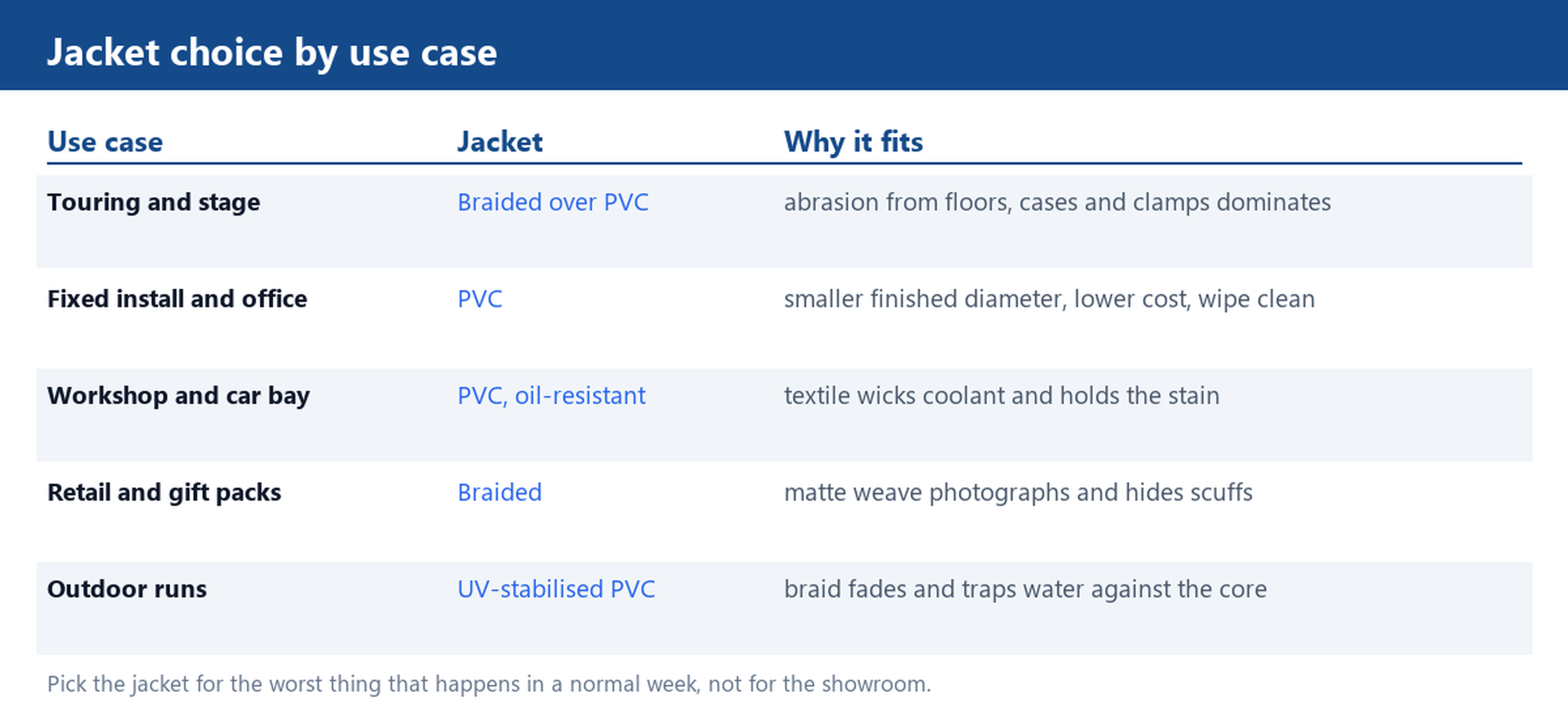
Name the worst thing that will happen to the cable in a normal week — dragged over a floor, crushed in a bag, coiled wet, or never touched — then match it:
- Touring and stage. Braided over PVC, because abrasion and handling dominate every other property.
- Fixed install and office. PVC, because nothing touches it and diameter matters.
- Workshop and automotive bay. PVC in an oil-resistant grade, because textile wicks coolant.
- Retail and gift packaging. Braided, because the unboxing is part of the product.
- Outdoor runs. Neither on its own. Specify a UV-stabilised compound and a path for water to drain.
How the choice changes tooling and repeat orders
Braid adds process steps: yarn sourcing, a braiding pass, and end finishing so the sleeve does not fray at the cut. Those steps lengthen the production cycle and add parameters to hold constant between lots. PVC adds none of that, but it locks in the extrusion die, so a diameter change on a repeat order means new tooling.
Either way, four items belong in writing before the first run: the compound and its rating, the finished outer diameter with a tolerance, a physical colour reference rather than a colour name, and the marking method — printed on the jacket, or on a sleeve. Agree those four and a repeat order becomes a part number. Leave them verbal and every lot becomes a negotiation.
Jacket samples of both constructions can ship with any quote. Send the drawing with the compound, the finished diameter and the marking method, and we will confirm feasibility. The customize cable page lists the options, and how to order lists the drawing fields we need.

Leave a Reply