

So, how long can a microphone cable be? A balanced microphone cable does not hit a hard wall at a fixed length the way an HDMI or a USB run does. Stage and studio crews run 10 m of XLR every day and the signal arrives intact. The real limits come from three places: how much top end the cable capacitance rolls off, whether the shield survives the route it takes, and whether the source is balanced in the first place. This guide walks through the physics, the lengths we build (1.5 m, 2 m and 3 m as standing options, plus custom runs up to 10 m), and the checkpoints to tick before you write the purchase order.
What Actually Travels Down a 3-Pin XLR Run
An XLR run is a balanced circuit. The microphone drives two signal conductors with mirror copies of the same waveform, and the preamp at the far end listens to the difference between them. Under the long-standing industry wiring convention, pin 2 carries the hot leg, pin 3 the cold leg, and pin 1 the shield. Because both signal legs travel the same path side by side, hum and radio interference induced along the route land on both legs at roughly equal strength. The differential receiver subtracts the common part, and the noise largely cancels.
That cancellation is why length behaves differently here than in an unbalanced guitar or consumer line, where one conductor carries the signal against a shield-as-ground and every metre of exposure converts noise directly into signal. A balanced run converts far less of it. The shield still matters: its job is to intercept interference and drain it to pin 1, and it also carries the return path for the standard +48 V phantom feed that travels out on the two signal pins and back through pin 1. A run can be electrically long and stay clean as long as the shield stays continuous and the connectors hold their grip.
Why Length Changes the Signal: Capacitance and High-End Roll-Off
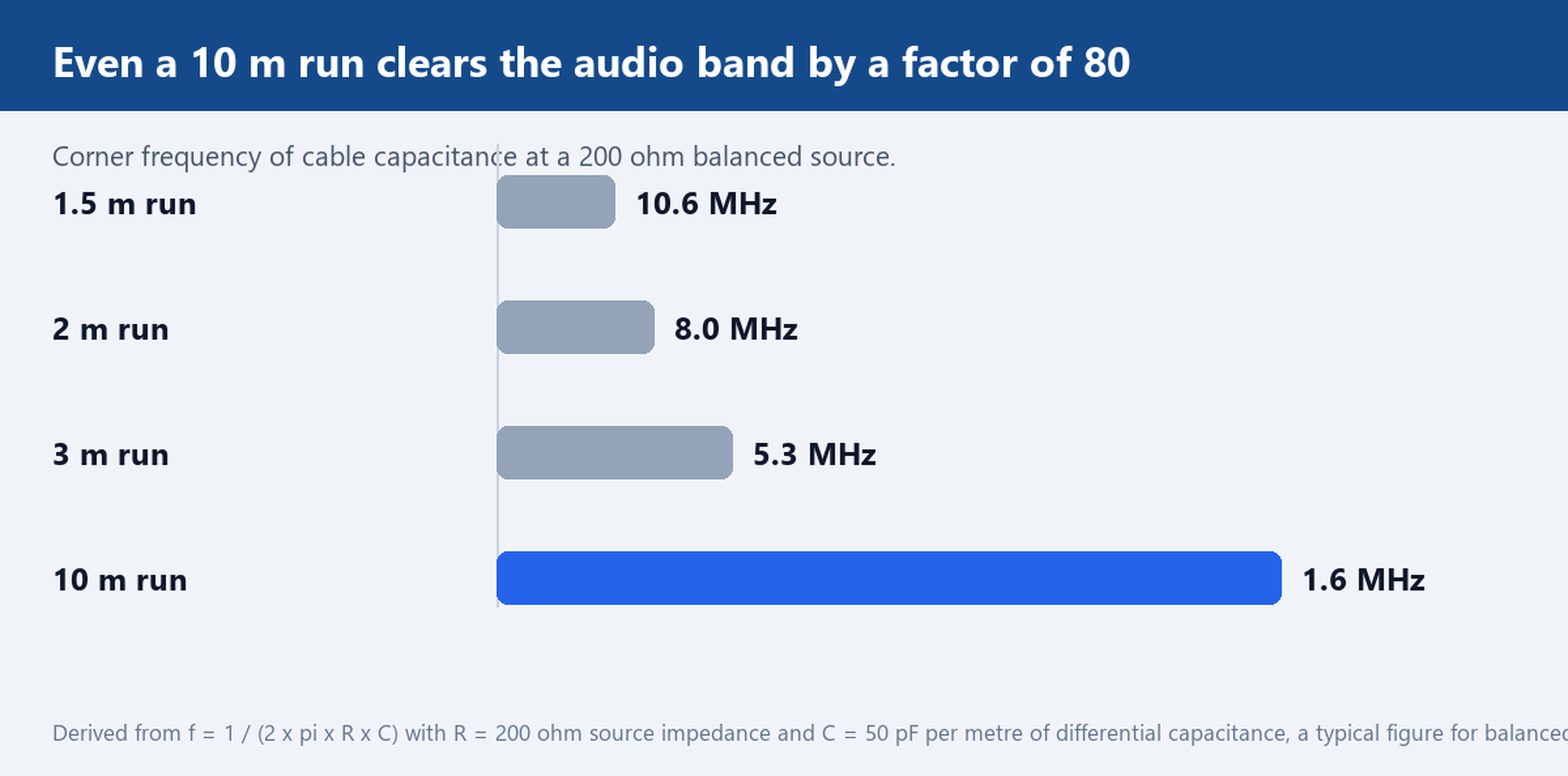
Every metre of cable adds a small capacitance between its conductors, and that capacitance leans on the high frequencies a little harder at every step. With a 200 ohm balanced source and a typical 50 pF per metre of differential capacitance, the corner frequency works out to roughly 10.6 MHz at 1.5 m, 8 MHz at 2 m, 5.3 MHz at 3 m and 1.6 MHz at 10 m. The audio band ends at 20 kHz, so even the longest of these sits about eighty times above the top of the band.
Read that the practical way: at microphone level, capacitance is rarely the binding constraint on run length. It starts to matter when a run gets very long and the source or the load moves toward the edge of the balanced model, for example a long unbalanced segment tacked on with an adapter. The enemies that actually fray a long run are mechanical and environmental: a shield that gets nicked by a door edge, a connector that works loose under foot traffic, a route that drapes across a mains loom or a dimmer rack. Plan the route with the same care you give the spec.
Lengths We Build: 1.5 m, 2 m, 3 m and Custom Runs Up to 10 m
Our braided XLR male-to-female microphone cable line is listed from 1 m to 10 m, and the three lengths that do most of the work on stage and in the booth are 1.5 m, 2 m and 3 m. The table below maps each length to the job it fits. Runs beyond 3 m go through the custom line up to 10 m, which covers the walk from a downstage vocal mic to a stage box on most floors and the trunk from a booth to a machine room rack.
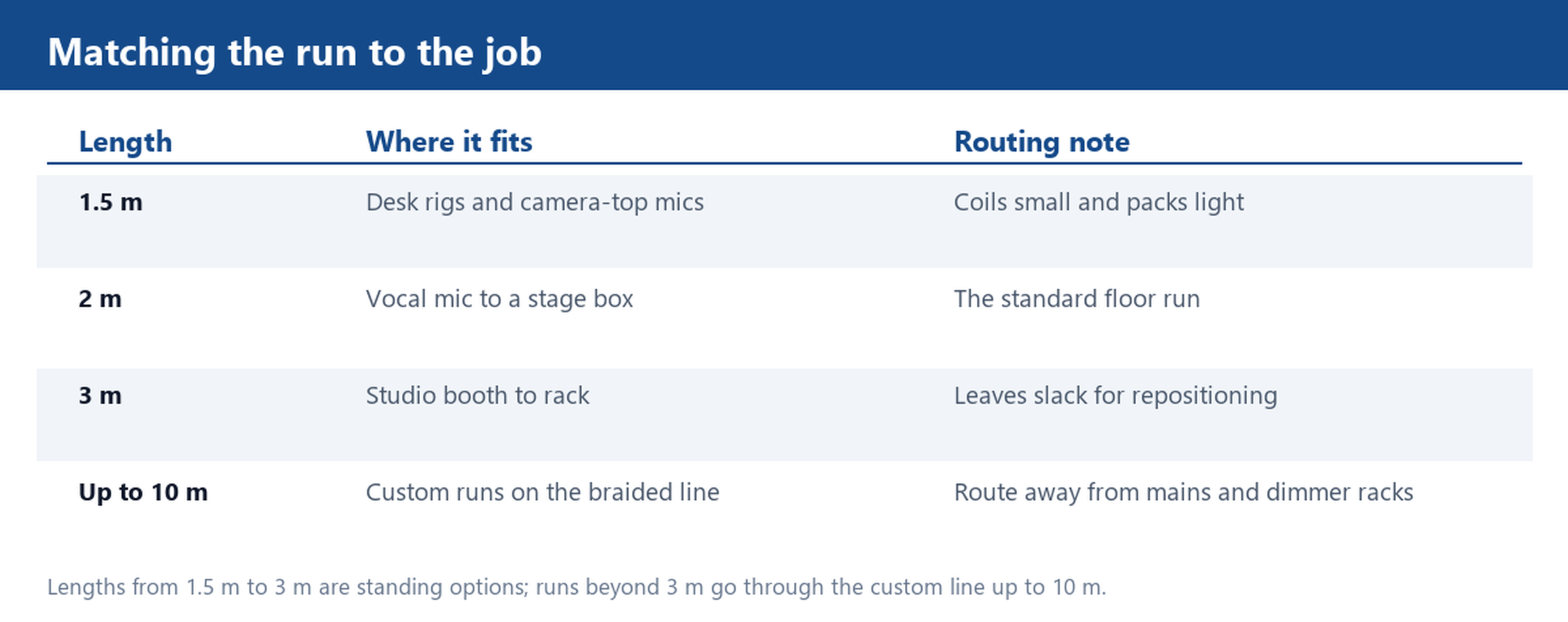
Jacket choice follows the route. The braided XLR cables take scuffing and coil handling better on stage, while the PVC XLR cables suit fixed runs inside racks and booths where the cable sits still after install. Both options carry the same 3-pin balanced construction, so the electrical argument above applies to either.
When a Passive Cable Is Not Enough: DI Boxes and Stage Boxes
The balanced-length logic holds as long as both ends of the run are genuinely balanced. An electric guitar or a consumer audio output is not: it is an unbalanced, high-impedance source, and stretching it across a stage with a long 6.35 mm lead is where length really does cost you top end and hum. The fix is a DI box at the source end. It converts the unbalanced feed to a balanced mic-level signal, and from there a standard XLR run of the lengths above behaves like any other.
For a stage with many microphones, a stage box or snake gathers all the XLR legs into one multicore trunk back to the console. Each leg inside still obeys the balanced rules, so the length guidance does not change; what the box buys you is tidy routing and connectors that get dressed and taped once instead of getting kicked every night. Keep the trunk away from mains and lighting looms, and cross any power cable you must at a right angle to cut the loop area that hum can couple into.
Writing the Purchase Order: Connector Ends, Braid and Pack Size
Four lines cover almost every order. First, the connector ends: male-to-female XLR 3-pin is the standard daisy-chain configuration for mic runs. Second, the length of each piece, matched to the route you measured rather than rounded to whatever is on the shelf. Third, the jacket: braided for stage routes that get coiled nightly, PVC for installed runs. Fourth, the pack: our line includes 2-pack and 6-pack XLR cable sets for outfitting a room in one go.
If the run you need is not a stock length, the custom cable service takes specified lengths up to 10 m, and the how to order page walks through quotations and sampling step by step. For a look at how the line is built, the factory page covers the production floor, and the full microphone and XLR cable category lists every configuration we ship.
Send us your stage or studio layout with the run lengths you need, and we will quote a pilot batch and ship a 3 m XLR sample for a bench test before you commit to the full order.