

Buying diagnostic cables for a fleet that runs both heavy trucks and light commercial vehicles comes down to one question asked before anything else: which socket does each truck actually have? Heavy trucks and buses carry the round 9-pin SAE J1939 connector, while passenger cars and vans standardized on the 16-pin J1962 OBD2 plug years ago. A diagnostic tool dealer serving a mixed fleet therefore ships two different worlds in one box, and the cable choice decides whether the kit works on the whole fleet or on half of it. This J1939 diagnostic cable guide walks the decision in order: identify the socket, pick the adapter topology, set the length, handle DB25 benches and legacy J1708 rigs, then write the order so the next batch fits the same socket.
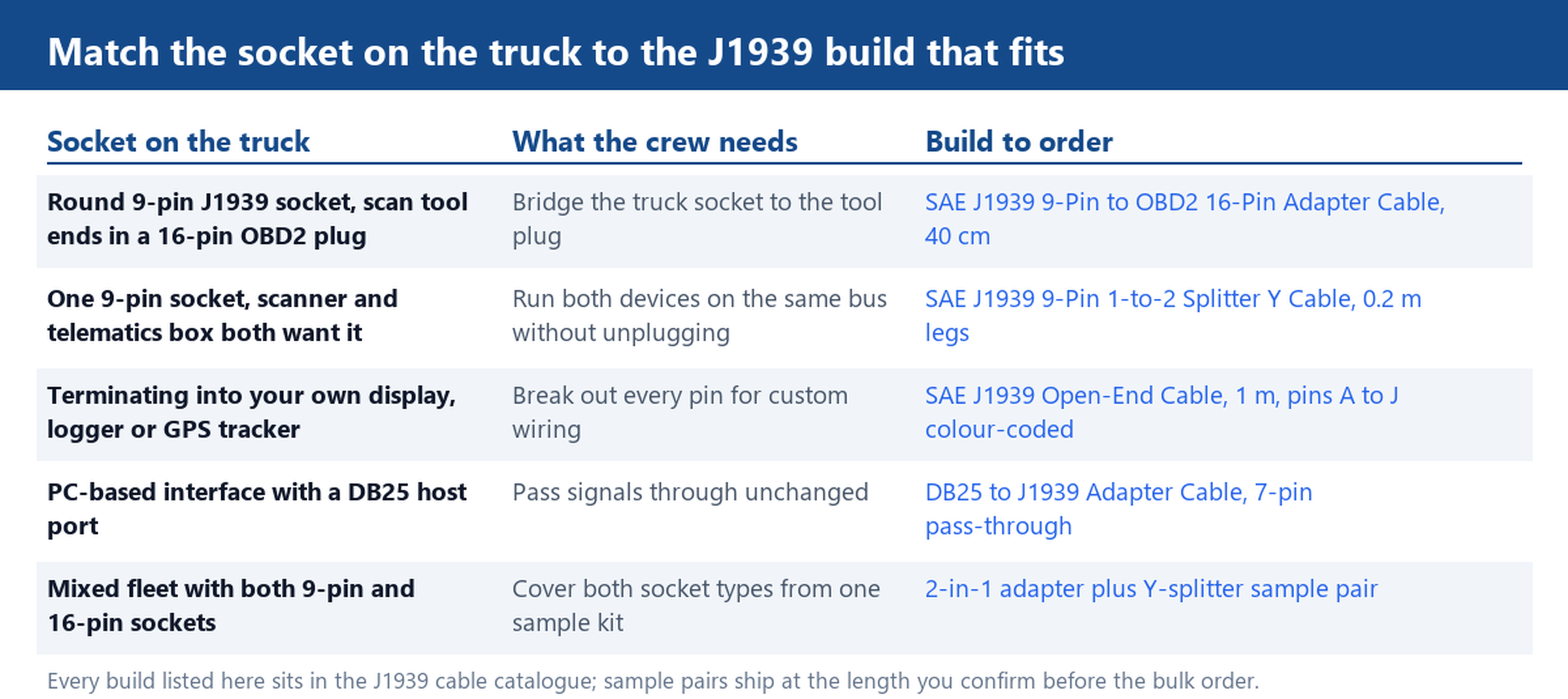
Which Socket Your Trucks Actually Have: 9-Pin, 16-Pin or Both
The two sockets are easy to tell apart on sight. The J1939 diagnostic connector on a heavy truck or bus is a round 9-pin Deutsch-style plug, usually found under or beside the steering column on the dash. The OBD2 connector on cars and light vehicles is the flat trapezoid defined by J1962, with two rows of pins inside a 16-cavity shell. Count the pins and the shape settles the question in seconds, which matters because a driver reporting from the road will not describe a pinout but will happily send a phone photo.
Each pin on the 9-pin socket has a defined job, and the assignments drive every cable in this guide. Pin A is ground. Pin B carries vehicle power at 12 V or 24 V, so any connected device has to accept the truck voltage. Pins C and D carry the J1939 CAN bus high and low lines, pin E is the CAN shield, and pins F and G carry the older J1708/J1587 serial link that some legacy equipment still speaks. When a cable order states those assignments, the receiving factory has nothing left to guess.
Adapter Topology: 9-Pin to 16-Pin, Y Splitter and Open-End Builds
Three topologies cover nearly every mixed-fleet situation. The first is the straight bridge: a SAE J1939 9-pin male head on the truck side and a 16-pin OBD2 female socket on the tool side, wired for the J1939 CAN signals and the J1708/J1587 pair. Our 40 cm adapter does exactly that, with over-moulded connectors, strain relief and a flame-retardant housing, and it lets a 16-pin code reader or GPS tracker talk to a truck that never got a J1962 socket. For dealer kits that cover both socket types with one part, the 2-in-1 version pairs the 9-pin male head with a 16-pin plug in the same lead.
The second topology is the Y splitter. Trucks grew one diagnostic socket and a growing list of devices that want it, and the splitter in the OBD2 Y-splitter range multiplies the socket: one 9-pin male feeds two female heads, so the scanner and the permanent telematics box run on the same bus at the same time. The honest engineering note belongs in the order conversation, not in the brochure: passive listeners and one active scanner coexist fine, but if both connected devices actively transmit on the bus, the device manuals have to confirm they are meant to share it. A splitter is wiring, not arbitration.
The third topology is the open-end lead, built for shops that terminate into their own hardware. Our 1 m version from the open-end cable range breaks out all nine pins with individual colours: pin A black, B red, C orange, D yellow, E brown, F green, G blue, H purple, J grey. That colour map turns the install into a wiring-diagram exercise instead of a continuity hunt, and it belongs in the project notes exactly as printed on the product page.
Length and Routing: 0.2 m, 40 cm and 1 m Options
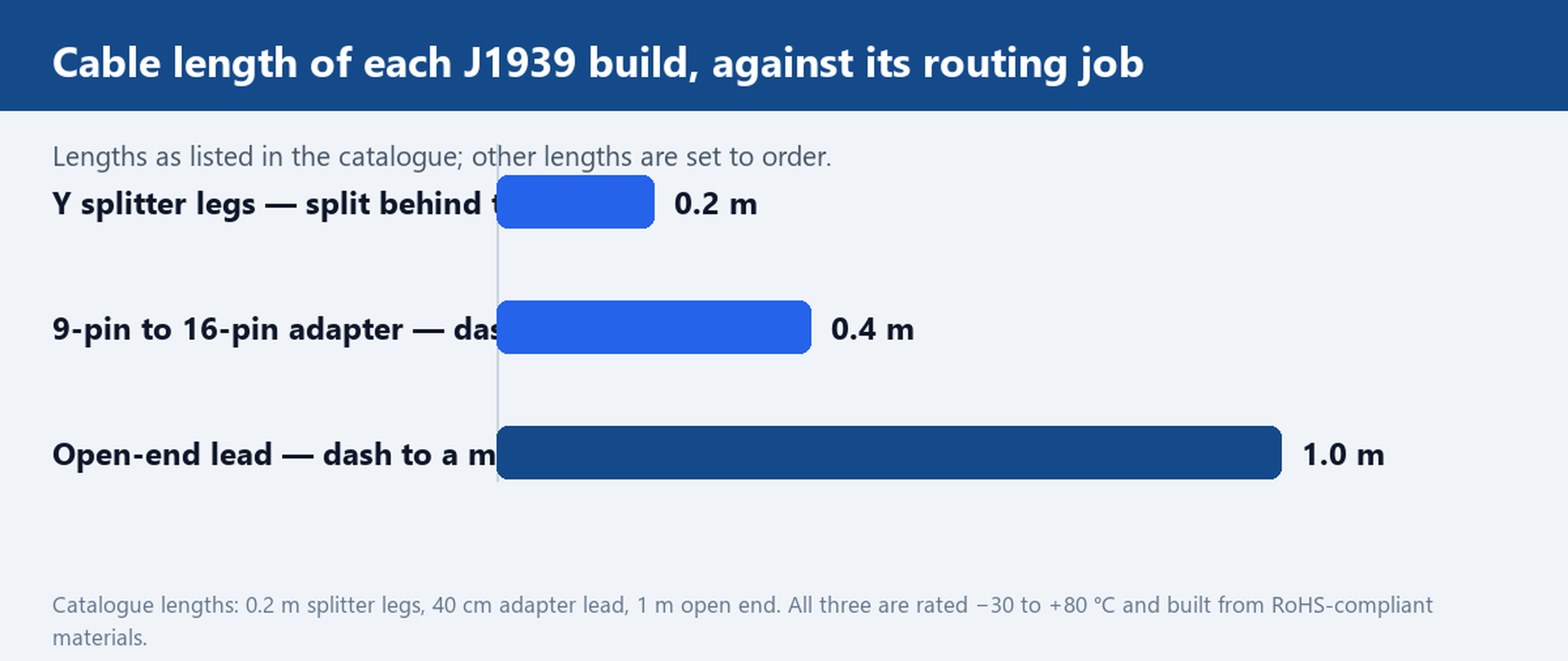
Length is a routing decision, not a preference. The 0.2 m splitter legs keep the split tight behind the dash, where surplus cable coils into the pedal area and catches boots. The 40 cm adapter lead reaches from the dash socket down to a seat-level scan tool without hanging near the pedals. The 1 m open-end lead runs from the dash connector to a mounted display or controller without leftover slack. All three builds share the same environmental envelope, working from −30 to +80 °C, and all three use RoHS-compliant materials, so the length choice never forces a downgrade elsewhere.
A quick bench check catches most length mistakes before they reach a customer: connect the intended tool at its intended mounting point, close the dash panel, and confirm the latch stays seated with the door swung open and the seat moved through its travel. Cables that pass that check stop coming back as returns.
DB25 Benches and Legacy J1708 Rigs: The 7-Pin Pass-Through
Bench-side equipment adds a fourth connector to the picture. PC-based truck diagnostic interfaces overwhelmingly speak DB25 on the host side, and the bridge to the vehicle is a DB25 to J1939 adapter with a pass-through pin design, so the signals the interface needs cross unchanged. The product line is listed as a 7-pin pass-through, and that number is a check item rather than a formality: J1939 devices vary in which pins carry the bus, and the line also has an 8-pin pass-through variant, so confirm the pin count your interface and vehicle actually use before ordering.
Legacy fleets add the J1708/J1587 question. Those serial signals live on pins F and G of the same 9-pin socket, which is why every adapter in this guide wires that pair through. A rig that predates CAN bus still gets covered by the same socket, provided the tool on the other end reads the serial pair.
Order Spec Wording So the Next Batch Fits the Same Socket
The failure mode in repeat ordering is a spec written from memory. Put the five fields in writing: connector A and connector B with gender, length, pin assignment, working temperature, and housing colour. Every one of those fields is settable to order on the J1939 cable line — length, connector type, pin assignment and housing colour are all custom options, with standard items starting from 100 pcs and custom builds from 500 pcs. The custom build process and the ordering steps are documented on site, and free samples come before the bulk run, so the sample pair is where the socket, the tool and the routing get proven together.
Send us the socket on your trucks and the scanner you bundle, and we will put together a 9-pin to 16-pin adapter plus a Y-splitter sample at the length you name. Test the fit on one truck of each socket type before the bulk order lands, and the same spec wording carries the reorder through without a single surprise.