

Choosing a speaker output cable comes down to three numbers: the current the amplifier can push, the length of the run, and the conductor area that keeps the loss small enough to be inaudible. Settle those and the connector question answers itself, because the twist-lock plug is the one part of the assembly that has to survive being pulled out and pushed back in every night. This guide works back from the amplifier output instead of forward from the plug on the shelf.
How to choose speakon cable: start from the amp output, not the plug
Write down two figures before opening any catalogue: watts per channel, and the lowest impedance the amplifier is rated to drive. Those two give you the current. A 1000 W channel into 4 Ω carries about 15.8 A rms and peaks near 22 A, because current is the square root of power divided by resistance. A 350 W channel into 8 Ω carries about 6.6 A. That current is what the conductor has to move without heating, and it is the figure a 1/4-inch jack was never designed around on a stage.
Then measure the run as it is actually dressed, not as the crow flies. Cable goes up a wall, around a monitor wedge, along the edge of a riser, and a 10 m straight line easily becomes 14 m of cable. That 40 percent matters, because loss scales with length and the margin you thought you had disappears with it. Our speakon cable range is built in the lengths stage crews actually order, but the maths below tells you which one to ask for.
Why a speaker output cable is not a microphone cable
A microphone cable carries a signal measured in millivolts plus a phantom supply of 48 V at a few milliamps. A speaker cable carries the full output of a power amplifier. The two look alike because both are flexible two-core cables in a round jacket, and that resemblance is where most rental-inventory failures begin: someone grabs the wrong drum, patches a mic cable into an amplifier output, and the shield becomes a heater.
Three differences decide the choice. Conductor area first: a typical mic cable uses conductors in the 0.2 to 0.3 mm² range, roughly 24 to 22 AWG, which is correct for millivolts and hopeless for 16 A. Shielding second: a mic cable carries a braid or foil tied to the connector shell, while a speaker cable neither needs nor should rely on one. Connector third: a mic cable ends in XLR, which is keyed and physically cannot be forced into a speaker output.
That keying is the point. The connector standard is what stops the wrong cable from being used, which is why the microphone and XLR cable family and the speaker output family should never share a shelf, a colour code or a label format.
12 AWG four-conductor: what the extra copper and the extra poles do
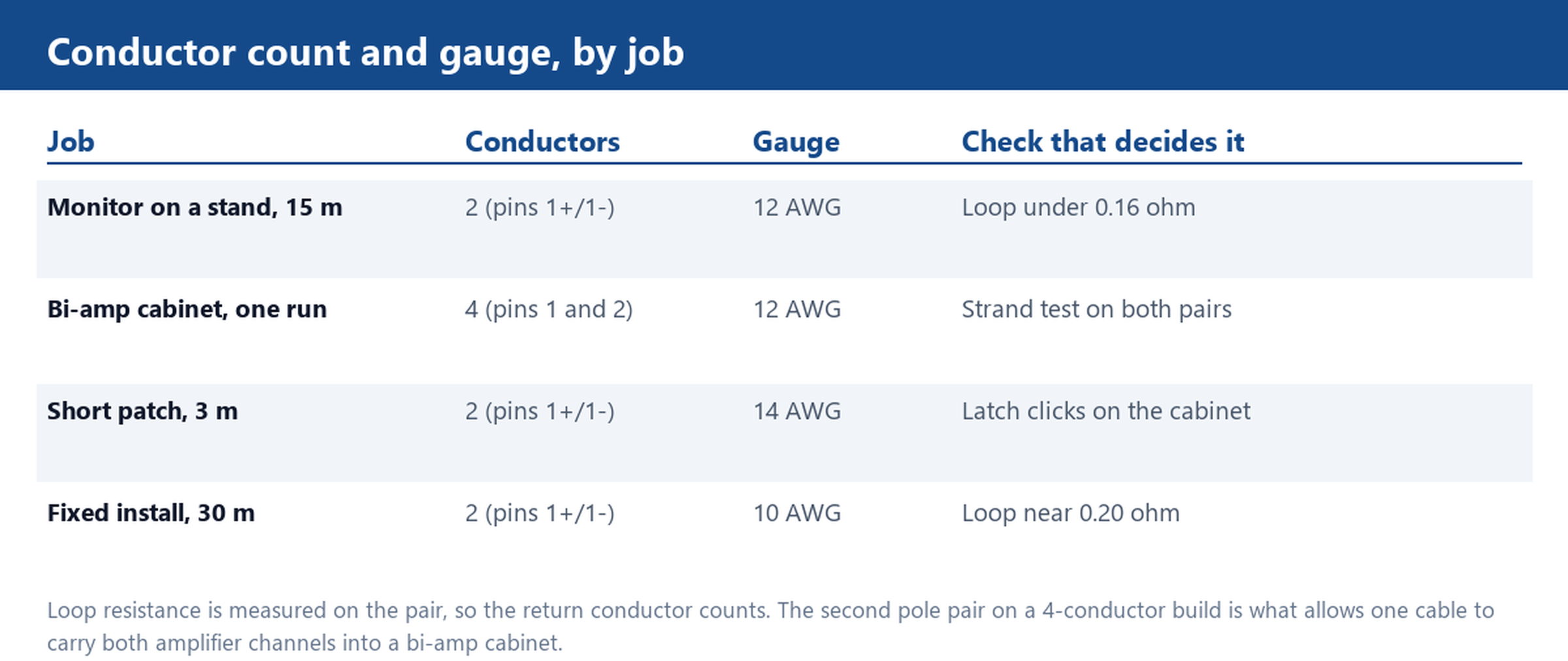
12 AWG is 3.31 mm² of copper per conductor. Four of those in one jacket make a cable that is noticeably heavier and stiffer than a two-core build of the same gauge, and that stiffness is the price of the second pair. The pair is not redundancy. On a 4-pole connector, pins 1+ and 1- carry one channel and pins 2+ and 2- carry a second, so one cable can feed a bi-amp cabinet with the low section on pins 1 and the high section on pins 2, from a single run instead of two.
Order two-conductor cable and that option closes. If the cabinet is bi-amp capable and the processor has two output channels per side, two-core cable means either running a second cable later or re-terminating the whole inventory. The extra copper costs less than the re-cabling, which is why the 4-conductor 12 AWG build is the version most touring accounts standardise on.
Then check the termination rather than the conductor count. The terminals inside a 4-pole plug sit close together, and one stray strand bridging 1+ and 1- makes a short that appears only when the cable is flexed. Ask for a pull test on each terminal and a strand count on the cut end; both are two-minute checks at the factory and impossible to recover once a container has shipped.
NL4 twist-lock vs 1/4-inch TS under road use
The 4-pole speakON family is rated around 30 A per contact, which covers what a large amplifier can deliver. The 1/4-inch TS plug was designed for instruments and line-level gear: it has no latch, its tip and sleeve can briefly short the output as the plug is withdrawn, and it is visually identical to an instrument cable. In a fixed installation none of that matters much. On a stage where cabinets move between sets, all three do.
Twist-lock answers the mechanical problem. Insert, rotate about a quarter turn until it stops, and the plug will not walk out under vibration. Release takes a deliberate pull on the latch sleeve, which is the right amount of resistance for a connector that should never come apart by accident. The cost is compatibility: the plug fits a speakON chassis socket only, so both the amplifier and the cabinet have to carry that connector.
Take the TS version only where the socket is already TS and cannot be changed, such as a legacy powered mixer or an installed patch panel. A speakon to 1/4-inch TS cable is the right adapter for that case, and the wrong default for everything else.
Length, gauge and the drop you can actually hear
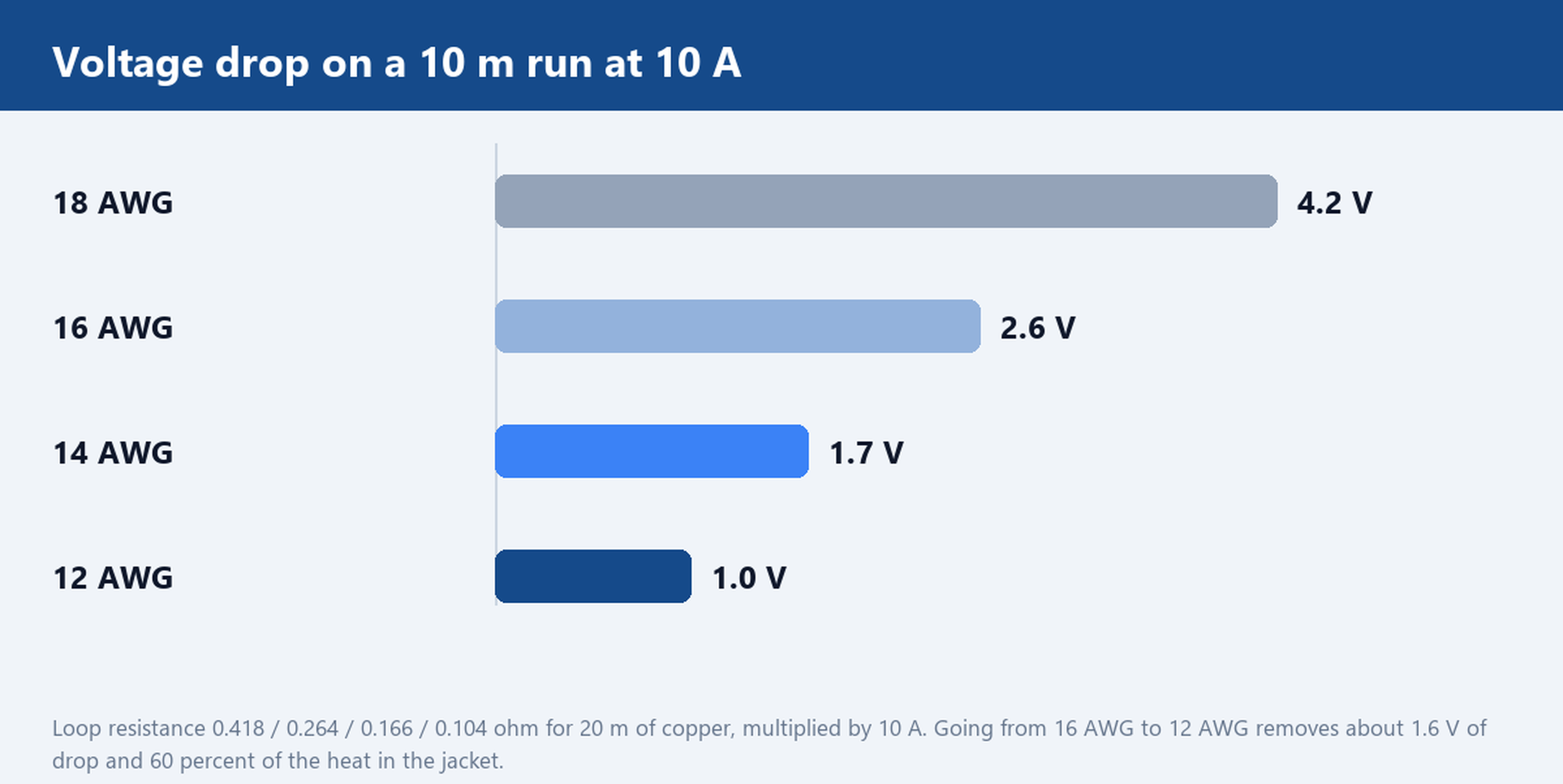
Copper resistance is fixed by cross-section. At 20 °C, 12 AWG measures about 5.2 Ω per kilometre, 14 AWG about 8.3, 16 AWG about 13.2, and 18 AWG about 20.9. A run uses two conductors, so loop resistance is twice the one-way figure: 10 m of 12 AWG is about 0.10 Ω, and the same run in 16 AWG is about 0.26 Ω.
Multiply by current to get the drop. At 10 A the 12 AWG run loses about 1.0 V and the 16 AWG run about 2.6 V. On a 50 V line that is roughly 2 percent against 5 percent, and the lost power becomes heat in the jacket: about 10 W against 26 W spread over the length of the cable.
The audible part is not the level, it is the damping. An amplifier with a damping factor of 200 into 8 Ω has an output impedance near 0.04 Ω. Add 0.10 Ω of cable and the total is 0.14 Ω, which puts effective damping near 55. Add 0.26 Ω instead and it falls to about 26. Low-frequency control is the first thing to go, and it goes as a loose one-note bass rather than an obvious fault, which is exactly why it survives a soundcheck and gets blamed on the room.
Practical rule: keep loop resistance under about 0.2 Ω. That allows 12 AWG to roughly 19 m, 14 AWG to 12 m, and 16 AWG to 7.5 m. Past those lengths, step up a gauge instead of accepting the loss, and treat any quote that lists length without gauge as incomplete.
Checks to run on a sample before ordering a container
Four checks catch most of what goes wrong, and all of them fit into an hour with a multimeter, a knife and the cabinet you plan to ship with.
Continuity and short test. Ring out 1+ to 1+ and 1- to 1- end to end, then confirm there is no continuity between 1+ and 1-. Repeat for 2+ and 2- on a four-conductor sample. Flex the cable hard at both plug exits while watching the meter; a reading that flickers is a strand bridging the terminals.
Conductor measurement. Cut 100 mm off one end, strip it back and measure the bundle. Nominal 12 AWG is 3.31 mm². A bundle measuring near 2.1 mm² is 14 AWG and one near 1.3 mm² is 16 AWG, whatever the jacket print claims, and the jacket print is the easiest thing in the factory to change.
Jacket and strain relief. Bend the cable sharply at the plug exit. A proper chuck and boot spreads the bend over 30 to 40 mm; a build that kinks at the shell will fail there first. Check the compound as well, because PVC stiffens in cold while rubber and TPE stay flexible, and that difference shows up in the first winter the kit travels.
Plug fit on the real cabinet. Twist-lock tolerance varies between moulds, and a plug that seats firmly on one socket can feel loose on another. Test on the cabinet shipping with the order, not on a bench socket in the office.
Then write the result into the purchase order: conductor count, gauge in mm², jacket compound, plug model, and the sampling ratio for incoming inspection. A line item reading speakon cable, 10 m cannot be inspected. A line reading four-conductor, 12 AWG, 3.31 mm², twist-lock both ends can, and that is the version a supplier can actually be held to. Browse the wider audio and video cable lines if the same order also covers line-level runs.
Send us the amplifier output per channel, the lowest impedance it drives and the run length you need. We will match the gauge, confirm the pole count and send a sample to fit-test on your cabinet before you commit to a container.