

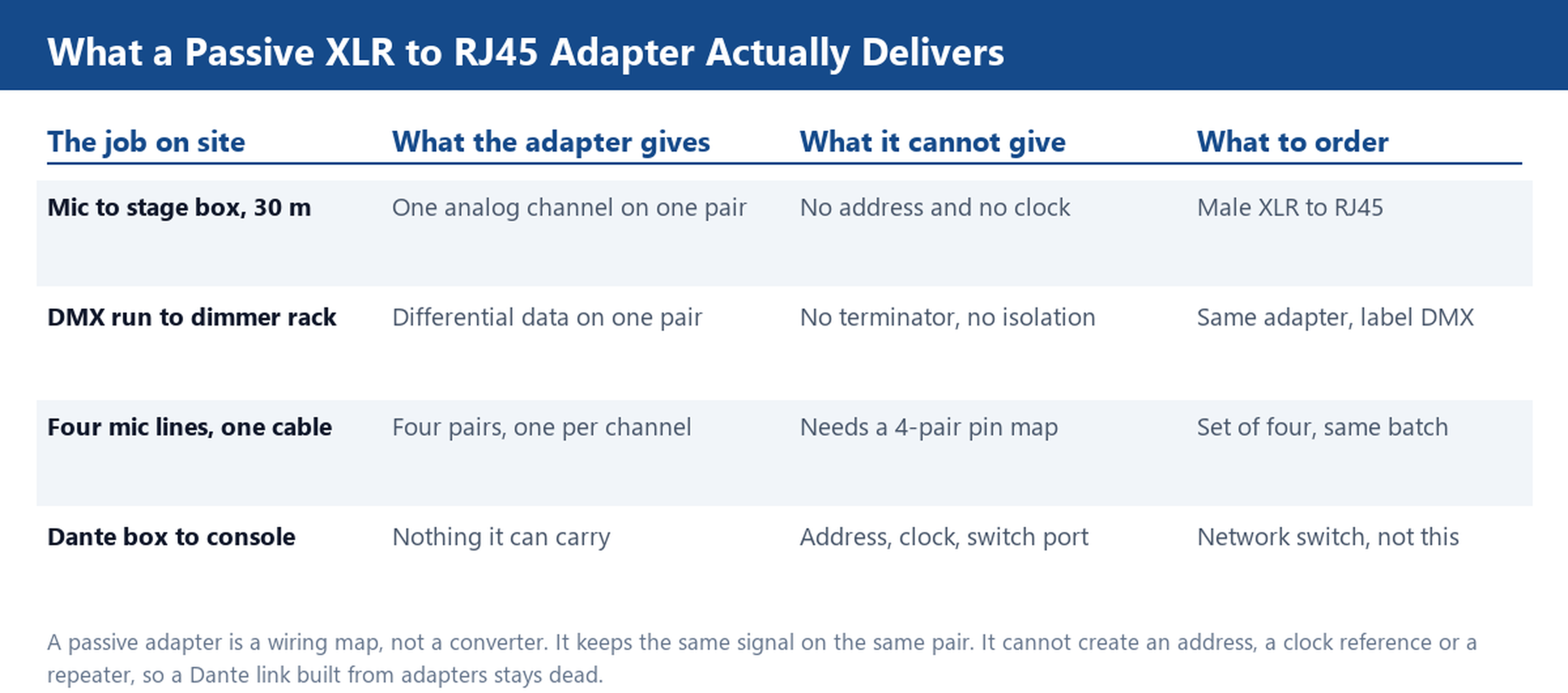
An XLR-to-RJ45 adapter and a Dante network both put audio on CAT cable, and that is where the resemblance stops. The adapter is a wiring map: three XLR pins land on one shielded twisted pair so an analog balanced signal, or a DMX512 data stream, can travel a longer distance on cheaper cable. Dante turns the same audio into IP packets, gives every device an address and locks the whole system to one clock. Order the adapter when the signal stays analog and both ends are fixed. Order network hardware when the devices have to be addressed, routed or shared. Choosing one when the job needs the other is a common reason a stage rebuild comes up silent.
What the Adapter Really Does: One Shielded Pair per Run
Open one and there is nothing inside but solder joints and a short moulding. The 3-pin XLR shell carries pin 2 (hot), pin 3 (cold) and pin 1 (shield). Inside the adapter, hot and cold cross to a single twisted pair and pin 1 lands on the drain wire or the foil of that pair. Some builds also bond pin 1 to the RJ45 metal shell. That is the whole product: no transformer, no amplifier, no chip, no termination network.
Everything an XLR-to-RJ45 adapter can do follows from that. It passes what the pair will pass and it passes nothing else. It does not improve common-mode rejection, it does not extend the reach of a signal that is already too weak for the distance, and it does not convert one protocol into another.
Two gender variants cover most orders, and they are separate line items rather than options on one part number. The XLR 3-Pin Male to RJ45 Female Adapter Cable is the part that feeds a console input from a wall plate or a patch panel; the XLR 3-Pin Female to RJ45 Female Adapter Cable is the part that takes a microphone or a DI box into the copper run. A venue that buys only the first ends up with a run it cannot terminate at the stage end.
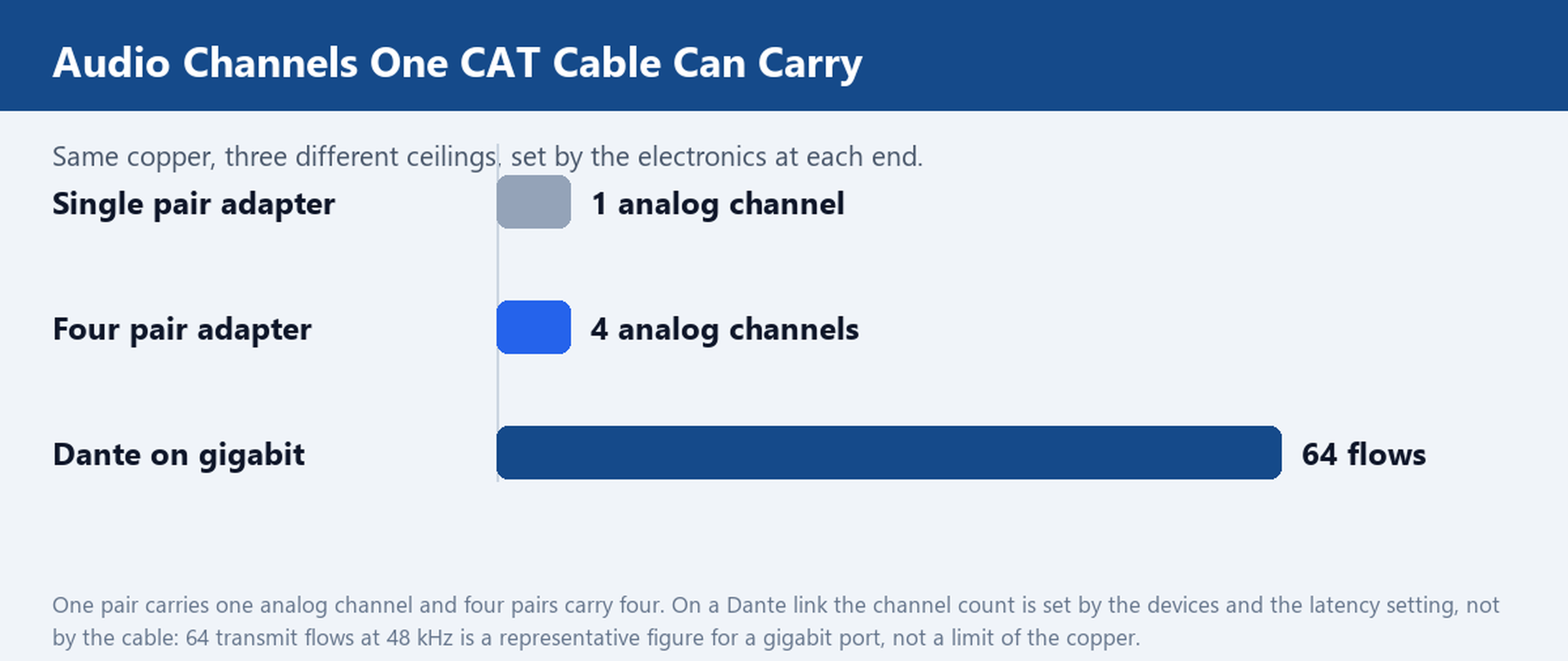
Count the pairs before ordering. A CAT-5e or CAT-6 cable holds four twisted pairs and eight conductors. A single-pair adapter uses two of those conductors, so three pairs sit idle in the same jacket. Four-channel adapters that use all four pairs exist and follow published pin maps, which is useful when a stage box has to feed four mic lines down one cable, but they are a different purchase with a different map. Our XLR cable sets are where most rooms start, because a set fixes the gender mix and the lengths in one line.
Analog Balanced Audio over CAT-5: Distance, Shield and Pin Map Risk
A balanced line carries the signal twice, in opposite polarity, and the receiving stage subtracts one from the other. Interference that arrives on both conductors equally cancels. That works as long as hot and cold stay twisted together to the last centimetre and the shield is bonded according to the grounding plan for the building: at both ends for a self-contained system, at one end where two separate power feeds meet.
Copper is rarely the limit. A shielded pair in a CAT cable has enough copper for a line-level signal over a typical install run, and mic level is the case that needs care because the signal arrives at a few millivolts. Two things shorten the usable distance: cable that has only foil and a drain wire instead of a braid, and routing that shares a tray with dimmer feeds or motor cables. For a run that passes a dimmer rack, specify a shielded construction and keep the audio pairs in their own jacket.
The risk that actually bites is the pin map. There is no single field convention that every supplier follows, and published four-channel maps differ from each other. If one end of a run is built to a map that puts hot on pair 1 and the other end expects hot on pair 2, the channel arrives polarity inverted: it still passes signal, which is why the fault survives a soundcheck, but the low end cancels against the other microphones on stage. If the maps disagree about the shield pin, the channel is simply dead. Confirm the map in writing for both ends, take both ends from the same production batch, and label the boot.
Phantom power deserves its own line on the order. A condenser microphone draws a small current at 48 V, and the thin conductors in a CAT cable add resistance that shows up as a voltage drop at the far end, so measure at the microphone rather than at the console. The mistake that costs a capsule is sending phantom down a pair that lands on a line-level input at the other end.
DMX512 Down the Same Copper: Why It Works and Where It Stops
DMX512 is differential data at 250 kbit/s on a 120 ohm twisted pair, with the shield on pin 1. Electrically that is the same job the audio pair does, which is why one adapter design serves both, and why lighting crews ran CAT cable to fixtures long before audio did.
What the adapter does not do is anything a data link needs beyond the wire. DMX512 is a daisy chain with a limit of 32 unit loads on a segment and a 120 ohm terminator at the far end. A passive adapter does not terminate, does not repeat and does not isolate. Where a run crosses between two power feeds, the adapter carries the ground difference with it, and the symptom is a flickering fixture rather than a clean failure.
Label both ends. A shared box of adapters is how a DMX line ends up plugged into a microphone input, and the failure then looks like a dead channel rather than a wrong cable. Coloured boots or a printed tag cost less than the hour spent finding it. Lighting and audio also part company at the splitter: an XLR splitter that is fine for one mic feed is not a DMX opto-isolator, and treating it as one is how a whole universe of fixtures goes dark.
What Dante Needs That a Passive Adapter Cannot Supply
Dante is audio over IP. Each device has a network interface with a MAC address, takes an IP address from a DHCP server or a link-local range, and joins a clock domain in which one device is the leader and the rest follow it through PTP. Audio travels as multicast or unicast flows, typically at 48 kHz and 24 bit, with latency set per device from a fraction of a millisecond upward. Routing is a software decision made in a controller, not a wiring decision made at a patch panel.
None of that exists inside a passive adapter. There is no PHY, so the port at the far end may not even negotiate a link. There is no address, so nothing appears in the controller. There is no clock relationship, so even if packets appeared they would not be assembled into audio. This is the part buyers get wrong: the connector matches, the cable matches, and the link is still dead because the adapter was never a converter.
What the job needs instead is a switch, an address plan and a clock plan. A gigabit switch for anything beyond a couple of flows, quality of service enabled so clock traffic is not queued behind bulk file transfers, and energy-efficient Ethernet switched off on the ports that carry the clock, because a port that idles its PHY can drop the packets that keep the system in sync. A 100 Mbit link will carry a small channel count, but that is a decision to take deliberately rather than by accident.
Telling the Two Apart on Site: Ports, Switches and the Clock
The diagnostic is the clock, not the connector. An RJ45 port on a console can be Dante, AES50, MADI over CAT cable, a proprietary stage-box link or a service port, and from the outside they look identical. Three questions separate them in about a minute.
First, does the port show a link light when a laptop is connected? If yes, it is Ethernet, and probably Dante. Second, does the device have a clock setting or a sync indicator? If the console owns the clock and the stage box follows it over a fixed link, that is a proprietary link, and no adapter will bridge it to a different brand. Third, does the device appear in a routing application? If it does, the addressing layer already exists and the job is a network job.
Before the show, prove the analog path on its own. Connect a known microphone through the adapter pair into a known input, confirm level and polarity, then swap in the console path. Working in that order means a fault gets attributed to the right half of the system instead of to the whole chain. The microphone and XLR cable range is built for that first test, and it is also what most rooms should be using when the run never needed to leave analog.
Ordering Matched Pairs: Gender, Pin Map and Spares
Installed work consumes adapters in pairs, so order male and female in equal quantity. The stage end is usually a female XLR wall plate that a microphone plugs into, and the console end is usually a male plug into the desk. A count taken from the drawing rather than from the rack will be short by the number of spare points.
Put three things on the purchase order: the pin map for both ends, the batch so that mixed maps cannot creep in across a phased install, and the marking convention. Add a spare ratio of roughly one adapter per eight runs; the part is inexpensive and the site visit is not. Where the room is being built rather than repaired, the same discussion belongs in the custom cable brief, because the adapter and the run behind it are specified together.
Finally, decide what the CAT cable between the two adapters is. The adapter is a short patch, typically a fraction of a metre, and the field run is the part terminated on site, so specify the category, the plug type and whether the run is shielded. A matched set of adapters on unshielded foil cable is a compromise nobody decided on.
Send us the console and stage-box port list for the room, and we will confirm the pin map in writing and quote matched male and female adapters as one pair, with the shield and gender variants fixed before anything is built.