

Retractable USB cables are bought for one reason: the lead has to disappear when the charge is finished. That single requirement rewrites half of the specification sheet. The 1 m figure on a spool is the length at full pull, not the reach you get with the body resting on a desk, and a flat TPE noodle that thin settles at a 5 V, 2 A ceiling rather than the 3 A a moulded round assembly can pass. Fix those two numbers before the packaging art is drawn, and the rewinding mechanism stops being the source of returns.
Reach vs Straight-Length: What 1 m Means on a Spool
On a fixed-length lead, reach and length are the same number. On a spool they are not. Pull the lead to the ratchet stop and the tip-to-tip length reads 100 cm, which is a manufacturing figure measured hook to hook. The reach that matters in a car is shorter, because the reel body needs a flat surface to sit on and the lead leaves that body through one fixed exit.
Measure from the socket centre to the device port along the path the lead will really take, leaving one loose curve at each end. In practice a 100 cm spool covers a console lighter socket feeding a handset clipped to the air vent, or a desk hub feeding a phone lying flat in front of it. It does not cover a rear-cabin socket feeding a device in the front, and it will not take a tight corner around a headrest post. When the straight-line run needs more than roughly 80 cm, order the fixed-length version instead of a longer reel: a longer spool does exist, but the body grows with the take-up drum and the surplus length is the part that tangles first.
The ratchet is what makes a short reach workable. The lead stops at the length that was pulled and stays there until a second tug releases the drum, so the user sets the reach once per trip rather than fighting spring tension. In the retractable USB cable range the 100 cm lead and the flat noodle profile are what keep the body small enough to leave in a pocket, which is the whole point of the format.
Why 5 V 2 A Is the Honest Rating for a Thin Retractable Lead
Charging current is set by copper, and a flat noodle body is the tightest copper budget in the catalogue. To keep the reel flat and the body pocket-sized, the conductor bundle inside a retractable lead is smaller than the bundle in a round jacketed lead of the same outside width. Ten watts, 5 V at 2 A, is the level that budget supports while still leaving headroom for the voltage drop across a 1 m run.
Two consequences are worth one line each on the retail card. First, there is no fast charge: the body carries no e-marker chip, so the assembly never negotiates above 5 V, and a handset that would happily take 9 V falls back to the standard 5 V rate without any error message. Second, the last part of the charge is slower than the first, because the device cuts current as the pack fills and the small drop in a thin lead shows up as a longer tail on the charge graph rather than as a fault. Neither point is a defect; both become complaints only when the packaging promised something else.
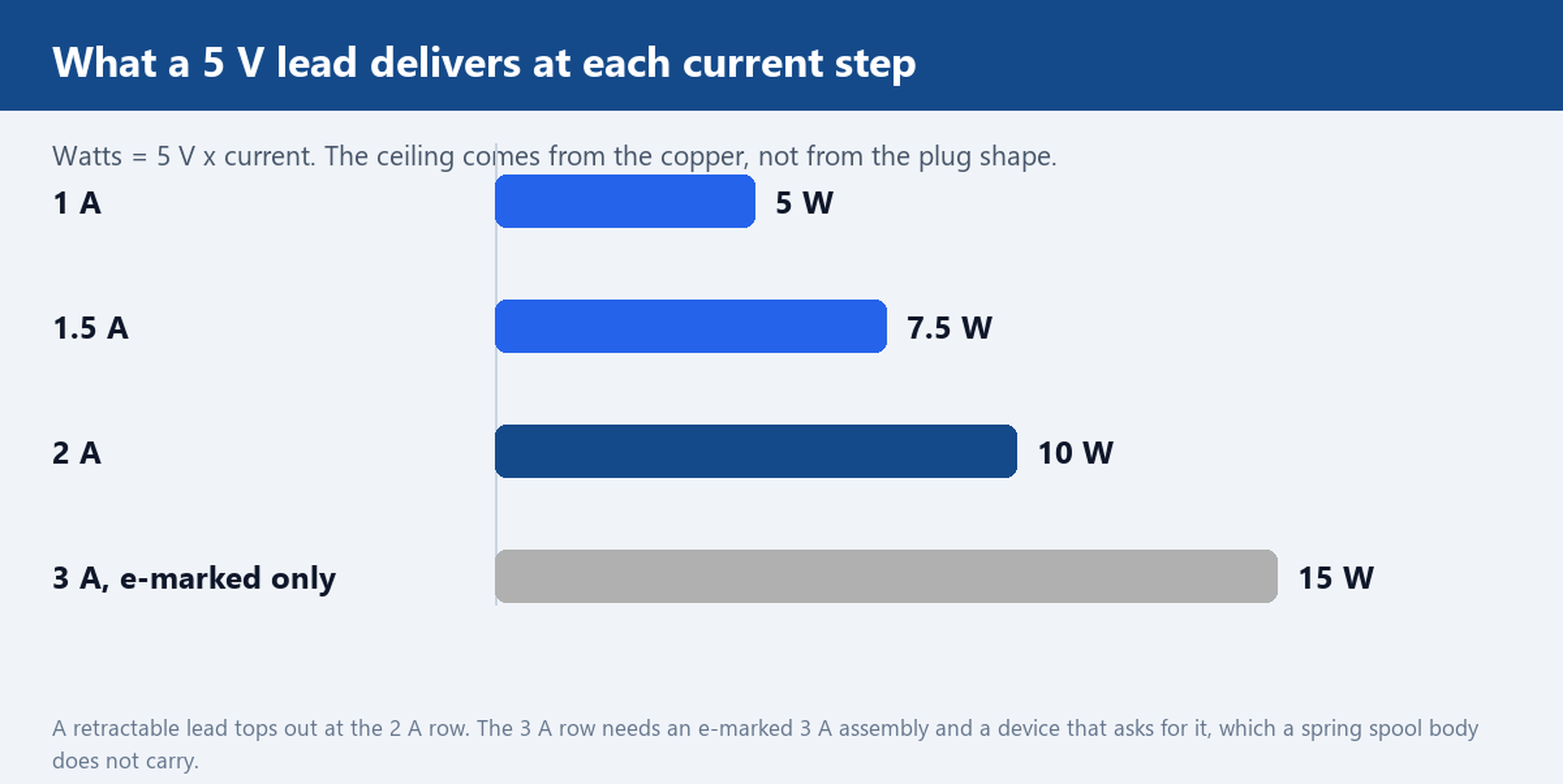
Where the 2 A rating pays for itself is at the returns desk. A card that says 5 V 2 A charge and sync, with no lightning bolt on the front, comes back less often than a card promising fast charge that quietly delivers five watts. The same rule applies to the Type-C version with one addition: state USB 2.0 data, because the reel will not carry SuperSpeed pairs and a buyer who expects a display link will not read the small print.
Tip Sets: Micro-USB, 8-Pin and Type-C Sharing One Spool
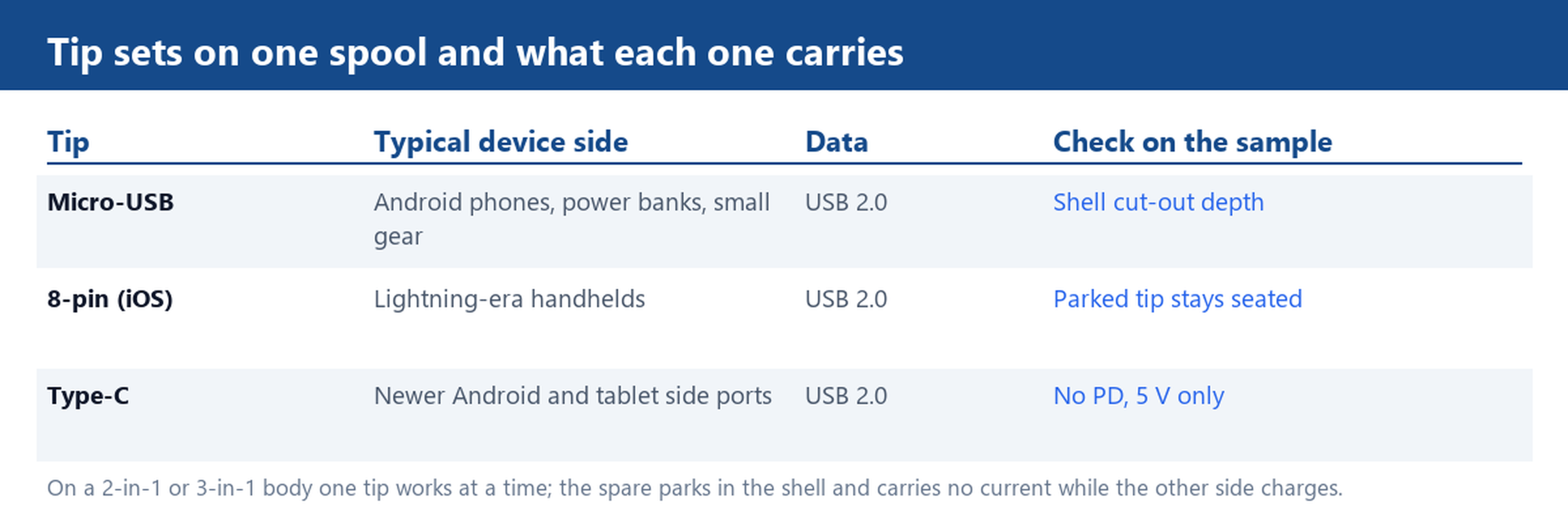
A 2-in-1 body solves the carry problem that two separate cables create, and it introduces a seating problem that a single-tip lead never has. Two tips on one head means one tip is always parked, and the parked tip is the one that collects pocket lint and gets pushed sideways when the body is dropped. On the 2-in-1 retractable TPE flat cable the head serves one tip at a time, Micro-USB or the 8-pin side, with the spare held in the shell.
Build the tip mix from the destination fleet, not from the largest single order. Micro-USB still owns the low-cost Android end, power banks and small accessories, and it is the tip that fails first when the shell cut-out is too shallow, because a thick case stops the plug short of the socket. The Micro-USB range and the 8-pin range both ship in the same reel body, so the choice is a head change, not a new tool.
Type-C needs a decision at the quoting stage rather than at the packing table. A 5 V lead with a Type-C plug will charge a modern handset, but it will not fast-charge it and it will not drive a display, so the honest label reads charge and USB 2.0 sync. Keeping one reel, one colour row and three heads is what makes a mixed order shippable; splitting into three separate SKUs triples the packaging work for the same container volume.
Rewind Cycles and Tip Seating: The Two Tests That Predict Returns
Returns on retractable leads cluster on two failures, and both are testable in about ten minutes on a sample, long before a purchase order is signed.
The rewind test is a pull-and-release run. Pull the lead to the ratchet stop and let it wind back, two hundred times, without pausing. Three things are being watched: whether the lead still winds fully flat against the drum, whether the ratchet still holds a set length without creeping, and whether the jacket at the exit grommet has started to kink. A spring that is rated for daily use will finish the run looking like it started; one that is not will leave a loop of slack hanging out of the body.
The tip seating test is a mechanical check, not an electrical one. Plug the tip into a device, hang the device from the plug for a minute, then repeat with the body swinging. The tip should hold with no rocking at the shell and no intermittent charge. Then check insertion depth with a thick case fitted: if the plug bottoms out on the case instead of the socket, the fault is in the cut-out, not in the connector, and it is the shape of the tip housing that has to change.
Ask for two facts in writing before volume: the cycle count the spring is rated to, and whether seating is checked per tip or per batch. A supplier who cannot put a cycle number into the quotation has not rated the part, which is different from rating it highly. The same discipline is worth applying to the whole reel assembly rather than to the lead alone.
Mounting Points and Colour Rows for Car, Desk and Retail
The body is the part that decides whether the product survives a car. A reel that hangs from the plug puts the whole load on the connector; a reel that sits on a surface puts it on the housing. For a lighter-socket install, the body needs a flat back and an exit angle that points the lead towards the device, so the first 10 cm of the run is not bent against the drum. For a vent or dash mount, a clip footprint smaller than the body keeps the reel from levering itself out when the lead is pulled.
Desk and travel use favour the pocket format instead: the body in a bag, the lead pulled to the laptop or the handset, the ratchet holding the length. That is where the flat noodle earns its place, since a round lead of the same reach coils into a spring shape that never lies flat again.
Colour is a per-order decision with real retail value. Six shell colours, blue, red, white, black, yellow and green, let one SKU serve a mixed shelf, and a printed logo on the body turns the reel into a giveaway that people keep. Orders that do not name a colour mix ship assorted, which is fine for a promotion and wrong for a planogram, so the mix belongs on the purchase order. Samples run three to seven days for approval, and colour, logo and retail packing all change at that stage rather than after tooling.
Send your target reach, tip mix and colour row, and we will ship a sample spool with the rewind cycle count and the tip-seating test results attached. Custom lengths and head combinations are quoted against the same reel body, so nothing in the drawing has to start over.