

Figuring out how to choose 90 degree hdmi cable for a wall-mounted television comes down to three checks that have to happen before the order, not after the bracket is on the wall: which way the elbow exits the socket, how much room the mount arm leaves behind the panel, and whether the run is short enough for a slim lead. Get those three right and the plug sits flush. Get any one wrong and the lead pushes the panel ten millimetres off the wall, or bends the socket mould until the shell cracks.
Straight, Right-Angle and Rotating Plugs Behind a Wall Mount
A straight HDMI A plug projects its own body length plus the bend radius of the cable. On a panel that hangs 25 mm off the wall on a fixed mount, that projection is the entire problem: the plug bottoms out against the plaster, the lead folds back on itself, and the strain lands on the socket shell instead of on the mould that was built to absorb it.
A right-angle plug turns the exit ninety degrees inside the mould. The lead then runs parallel to the back panel instead of away from it, which is what makes a 30 mm to 40 mm gap workable. The right-angle HDMI range covers six builds, from a 6 ft 1080p lead to a 20 m A-to-A run, so the exit direction can be matched to the socket rather than to whatever length happens to be in stock.
Rotating plugs sit in a third category. The 180 and 360 degree swivel builds put a joint between the contact block and the shell, so the direction can be set after the panel is on the wall. That joint is also a wear point. On a fixed mount that never moves, a solid elbow is the more rigid joint; on an articulating arm that swings out for service, the swivel earns its place because the lead is asked to follow the arm.
Which Way the Elbow Should Exit, and How to Check Before Ordering
Two photographs and one measurement settle this. The first photo is the back of the television with the mount plate already fitted, shot straight on so the socket row is visible. The second is the same corner from the side, with a steel rule held against the wall. The measurement is the clear gap between the socket face and the nearest obstruction, which on a tilting bracket is usually the vertical arm sitting directly behind the panel.
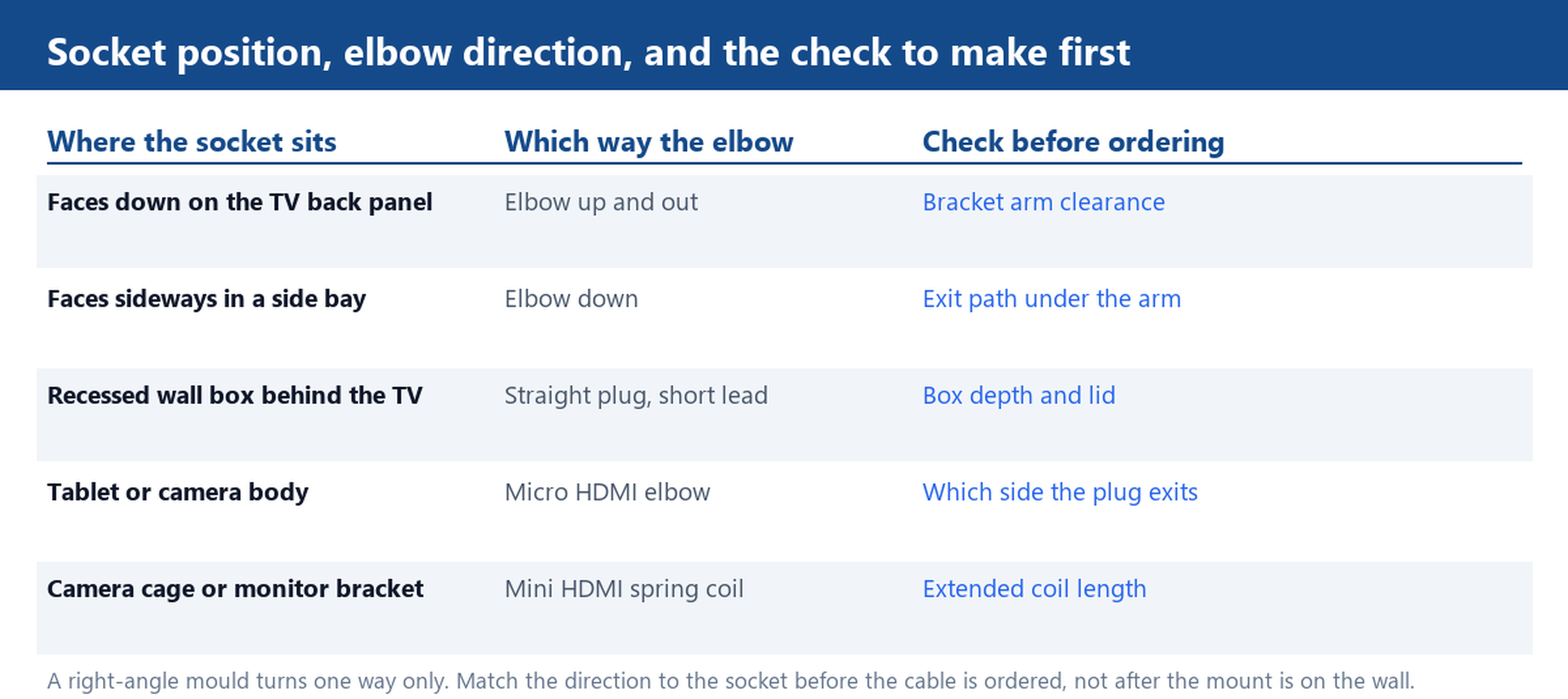
Then read the socket orientation and match it to an exit direction. An elbow that exits upward needs clear space above the socket, and on most panels the connector row sits low on the back, so upward is where the room is. Where the socket sits in a recessed side bay with the bracket arm below it, the elbow has to go down. Where the panel is fed from a recessed wall box, a straight plug with a short lead is the safer call, because a box 40 mm deep will not take an elbow plus a bend radius without crushing the jacket.
Write the direction on the purchase order: exit up, exit down, exit left, exit right. These are four distinct parts, and a fixed mould cannot be rotated to cover a second one. That single line item prevents the most common return on this product family, which is a cable that fits electrically and not mechanically.
Length and Conductor Build: A 20 m Run Is a Different Job
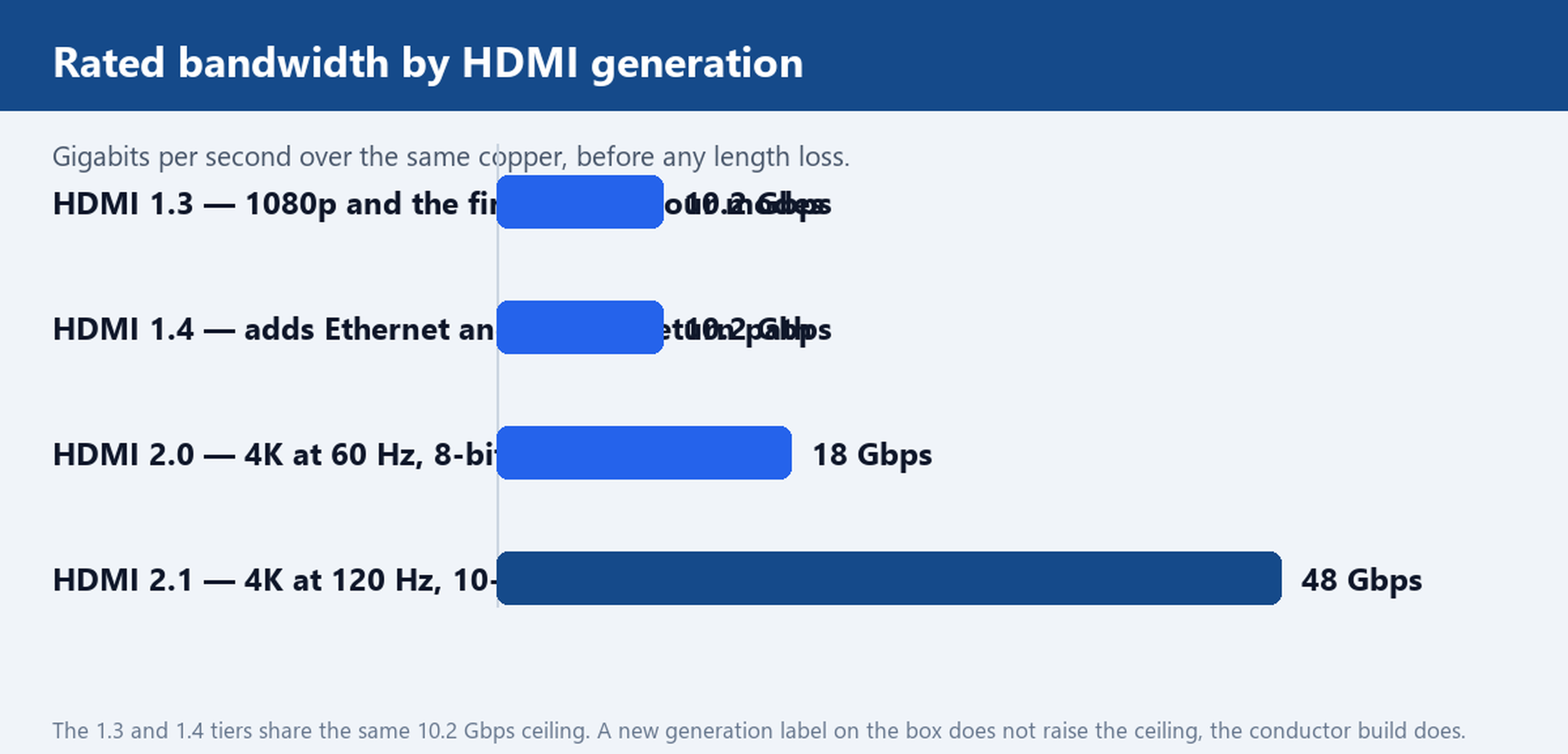
The 5.5 mm builds and the heavy 7.3 mm builds carry the same 10.2 Gbps rating on paper, but they are not interchangeable at length. The 20 m A-to-A right-angle cable is offered in 5.5 mm and 7.3 mm outer diameter with HDPE insulation, dual aluminium-foil plus braid shielding, and a choice of bare copper, tinned copper or CCS conductors. A 6 ft lead is a different specification again: the 6 ft right-angle build is a UL 20276 construction with oxygen-free copper, 24K gold or nickel plating, and a construction drawing that reads AWG (1P+D+AL+MY) x 5P+4C+AEB, rated 10.2 Gbps on the 1.3 and 1.4 versions and 15.2 Gbps on the higher one.
The practical rule: measure the run along the wall, add 500 mm of slack at each end for service, and treat anything past 10 m as a different job. Beyond 10 m, specify the 7.3 mm outer diameter and ask for the optional ferrite core, which is a clamp-on ring that suppresses the common-mode noise picked up when the lead is run parallel to a mains cable in the same cavity. Under 3 m, the thin build is easier to dress into a wall plate and does not load the socket.
Generation labels need reading with care. HDMI 1.3 and 1.4 share the same 10.2 Gbps ceiling; HDMI 2.0 lifts it to 18 Gbps and HDMI 2.1 to 48 Gbps. A right-angle mould does not change bandwidth. The conductor and the length do, which is why a 20 m elbow cable sold as 1.4 and a 2 m elbow cable sold as 2.0 behave differently in the same install.
Micro HDMI and Camera Rigs: The Right-Angle End That Saves a Socket
Tablets, action cameras and small monitors use the Type D Micro HDMI socket, and that socket sits on a board that flexes. Here the elbow matters more than on a television, because a straight plug hanging off a handheld device levers against the board every time the device is set down. The Micro HDMI builds here put the right-angle moulding on the Micro end and run to 10 m (33 ft) at 10.2 Gbps in a 5.5 mm jacket, in black, red or white, with ATC, CE, FCC, RoHS and REACH compliance.
Camera cages and monitor brackets have a different constraint: the gap between the camera body and the monitor is often under 100 mm, and a fixed elbow can point the lead straight into the cage. The spring coil Mini HDMI lead solves that with an L-shaped 90 degree Mini plug, 19 tin-plated conductors, triple shielding and gold-plated contacts, plus a coil that extends when the rig opens and pulls back instead of dangling into the shot. State the extended length you need and the coil is set to match.
Carton Checks: Plating, Shielding and the Certificates to Ask For
Plating is a corrosion decision rather than a signal decision. Gold over nickel contacts resist the sulphide film that builds up in a humid room over years, and the 24K gold option on these builds is worth the increment on anything that will be plugged and unplugged. Nickel alone is adequate for a plug that goes in once and stays.
Shielding is layered for a reason: aluminium foil handles the high band, the braid handles the low, and the pair together hold up when the lead shares a cavity with mains wiring. On a long right-angle run, ask whether the foil is bonded to the drain wire, because an unbonded foil behaves like a floating plate and does very little.
Certificates: ATC for HDMI conformance, CE and FCC for the destination markets, RoHS and REACH for the material declarations, and UL 20276 for the cable construction on the 6 ft build. Ask for the test report and the construction drawing with the first order rather than the third, because the drawing is what tells you whether the part in the carton matches the part on the quote. Ordering steps for custom lengths and jacket colours are documented on the how to order page.
Send a photo of the port and the measured mount clearance, and we will confirm exit direction, length and conductor build, then quote with a free sample so the fit can be checked against the actual bracket.