
Custom Audio Video Cable OEM: The Specs to Lock Before Ordering
Most custom cable quotes come back late because the request was incomplete, not because the factory is slow. A drawing that leaves out pinout, gauge, jacket, marking or packaging forces a round of questions, then a re-quote, and often a sample that fails on a detail nobody wrote down. The six fields below decide whether the first quote is usable.
This page is for the person building the RFQ on a custom audio video cable OEM program: what to lock, in what order, and what has to appear on the drawing so a factory can answer in one pass.
The specs to lock before you ask for a quote
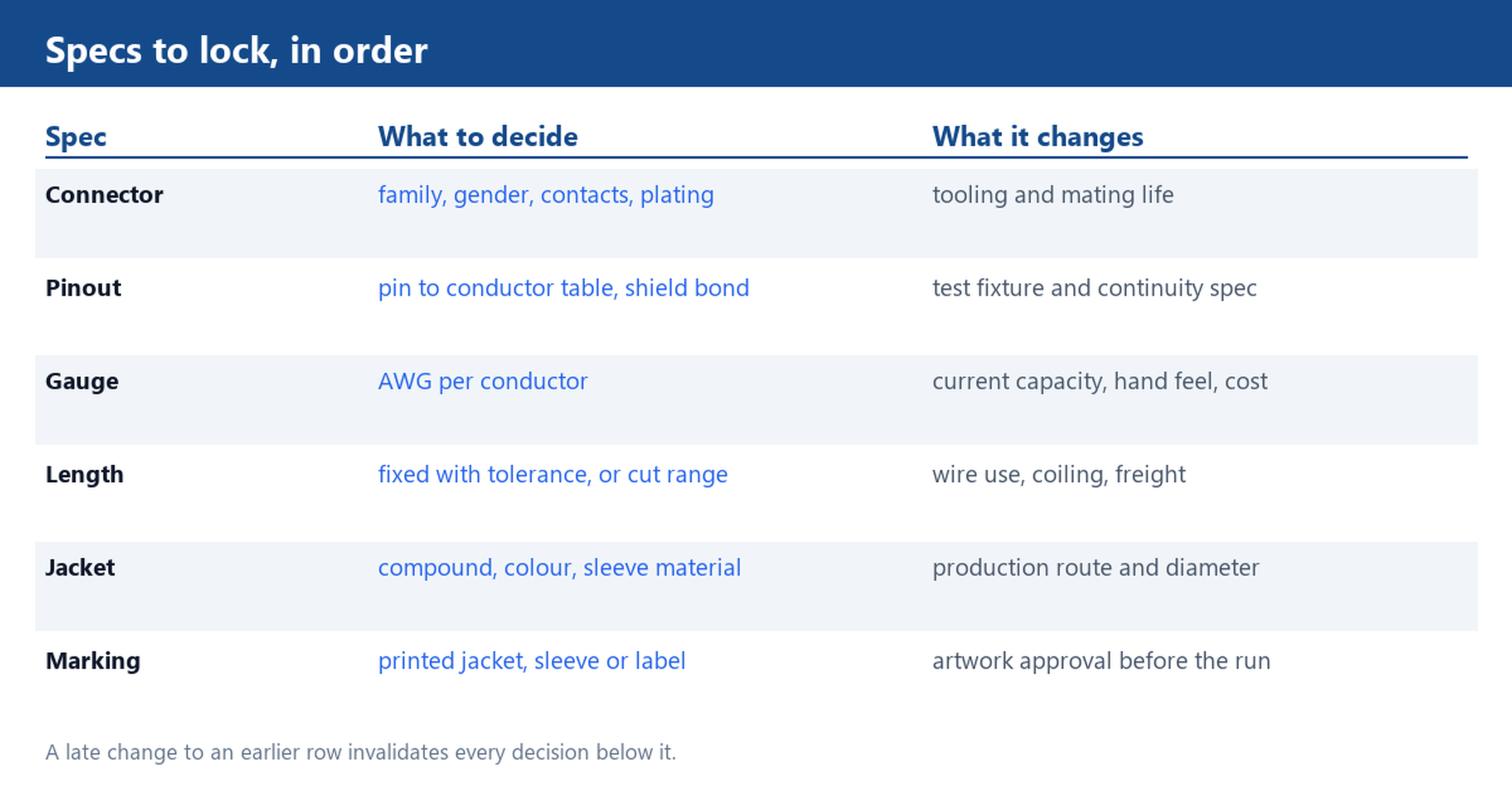
Six fields account for most of the cost difference between two otherwise similar assemblies, and they constrain each other in a fixed order.
Connector type and plating fix the tooling and the mating life. Pinout fixes the test fixture. Gauge fixes current capacity and hand feel. Length fixes wire consumption and packing. Jacket fixes the production route. Marking and packaging fix the approval cycle, which is usually the long pole — artwork sign-off, not the cable, is what holds a run.
The order matters: a late change to an earlier field invalidates every decision after it, and a jacket change after the sample means a new production route.
Connector and pinout: what belongs on the drawing
Name the connector family, the gender, the contact count and the plating. For audio and video assemblies that usually means an XLR 3-pin plug, a 6.35 mm TS or TRS plug, an RCA, a Speakon, or a 3.5 mm TRRS jack. Plating deserves more attention than it gets: nickel is the sensible default, and gold is for repeated mating against gold contacts.
Pinout belongs on the drawing as a table, never as a sentence. For a balanced XLR assembly, state pin 1 to shield or drain, pin 2 to tip or positive, pin 3 to ring or negative, and say whether the shell bonds to the shield. For a TRS to dual RCA splitter, state which conductor lands on which RCA centre pin. If the part is an adapter, add the direction: male to female, or female to male.
This is the most common cause of a wasted sample. Two factories can build the same connector list and produce two electrically different parts, and neither is wrong until the drawing says which one it wanted.
Length, gauge and shielding: how each one moves the cost
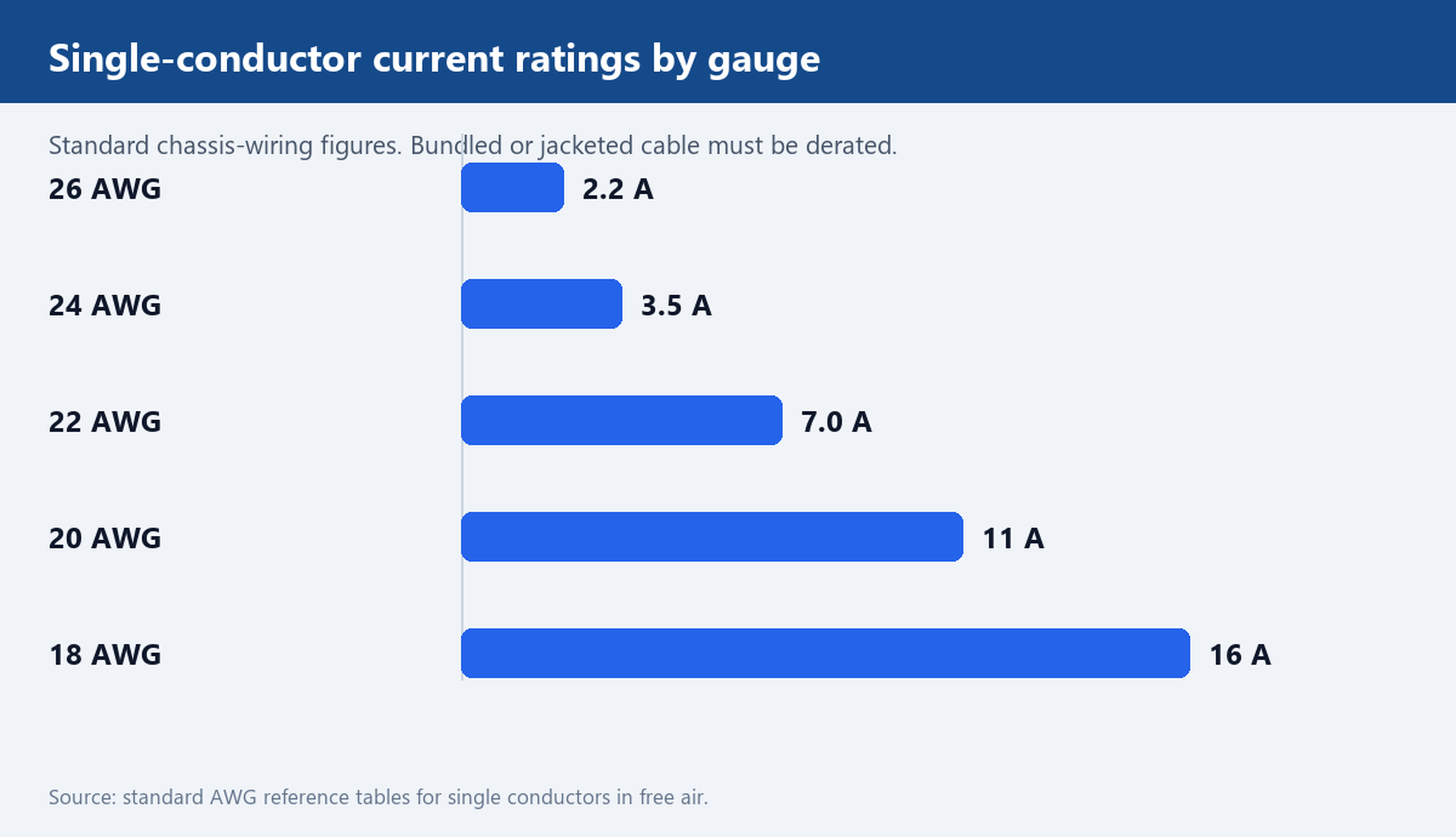
Gauge sets current capacity and hand feel at once. For a speaker run, 12 AWG to 16 AWG covers most stage work; for a line-level patch, 20 AWG to 24 AWG is normal. The chart above gives standard single-conductor chassis-wiring figures, and any bundled or jacketed run has to be derated from them because heat cannot escape the same way.
Length is not just more wire. It changes coiling, packing, freight weight and sometimes the strain relief. Specify fixed lengths with a tolerance, or a cut range, and state whether the length is measured over the moulded ends or pin to pin.
Shielding is where thin quotes hide. Foil plus a drain wire is the economical choice for line-level runs that never move. A spiral copper shield suits microphone cable that will be coiled thousands of times. A braided copper shield gives the highest coverage and adds cost and stiffness. Put the coverage percentage on the drawing, because a shield with no stated coverage cannot be checked at incoming inspection.
Strain relief, jacket and overmould: the parts buyers leave off
Three details decide whether the assembly survives its first month, and all three are usually missing from a first RFQ.
Strain relief. State the moulded boot length, the flex direction if the part is right-angled, and whether the assembly must pass a pull test. A right-angle plug with a long boot does not fit the same panel cutout as a short one.
Jacket. Name the compound and the colour, and say whether printing goes on the jacket or on a sleeve. For a braided construction, add the sleeve material, because nylon and polyester behave differently under abrasion and under flame.
Overmould. Specify hardness and finish. A soft mould grips and hides a poor fit; a hard mould holds shape but can crack at the boot if the compound is wrong for the temperature.
Labeling, packaging and kitting for retail-ready orders
If the cable goes on a shelf, the packaging carries as much of the order as the cable does:
- Marking. Part number, length and rating printed on the jacket, on a heat-shrink band, or on a wrap label.
- Unit pack. Poly bag, zip bag with a header card, or a printed box. Bag dimensions change the carton count and the freight cost.
- Multipacks. A two-pack or six-pack needs its own artwork, its own bag and its own carton count.
- Artwork files. Supply vector files with fonts converted, plus a dieline for any printed carton. Raster artwork gets redrawn by someone, and that is where brand errors enter.
None of this changes the cable. All of it changes the schedule.
What the factory needs to quote in one round
A complete RFQ for a custom audio video cable assembly carries seven things: connector list with plating, pinout table, gauge per conductor, length with tolerance and measurement basis, jacket compound and colour, shield type with coverage, and marking plus packaging artwork. Add the quantity by configuration and the destination, and the quote needs no assumptions.
Two notes on sending it. A marked-up photo is acceptable as a starting point but must be replaced by a drawing before tooling. And say which fields are fixed: a factory that knows gauge is negotiable will suggest a cheaper gauge.
When a second sample round happens, the cause is nearly always one of four things: an ambiguous pinout, an unstated length measurement basis, artwork that arrived as a raster file, or a jacket change requested after the first sample. Each is preventable at the RFQ stage.
Send the drawing or spec sheet as you have it, even incomplete, and we will mark what is missing and confirm feasibility against the build you intend to run. The audio and video cable category shows the constructions we run most often, including the 12 AWG Speakon speaker assembly. The customize cable page covers the options, factory covers the process, and how to order lists what a first RFQ should carry.