

Ordering an iPhone charging cable for resale is a connector problem before it is a price problem. Pick the wrong head and the whole batch is dead stock: a 30-Pin plug will not enter an iPhone 8, and an 8-Pin plug will not enter an iPhone 15. This guide walks through the three connector generations, the mixed-head builds that cover a varied fleet, what the 2A and 2.4A labels on the jacket actually refer to, the stock lengths that move in retail, and the paperwork and sample checks to finish before you confirm a bulk order of any iPhone charging cable.
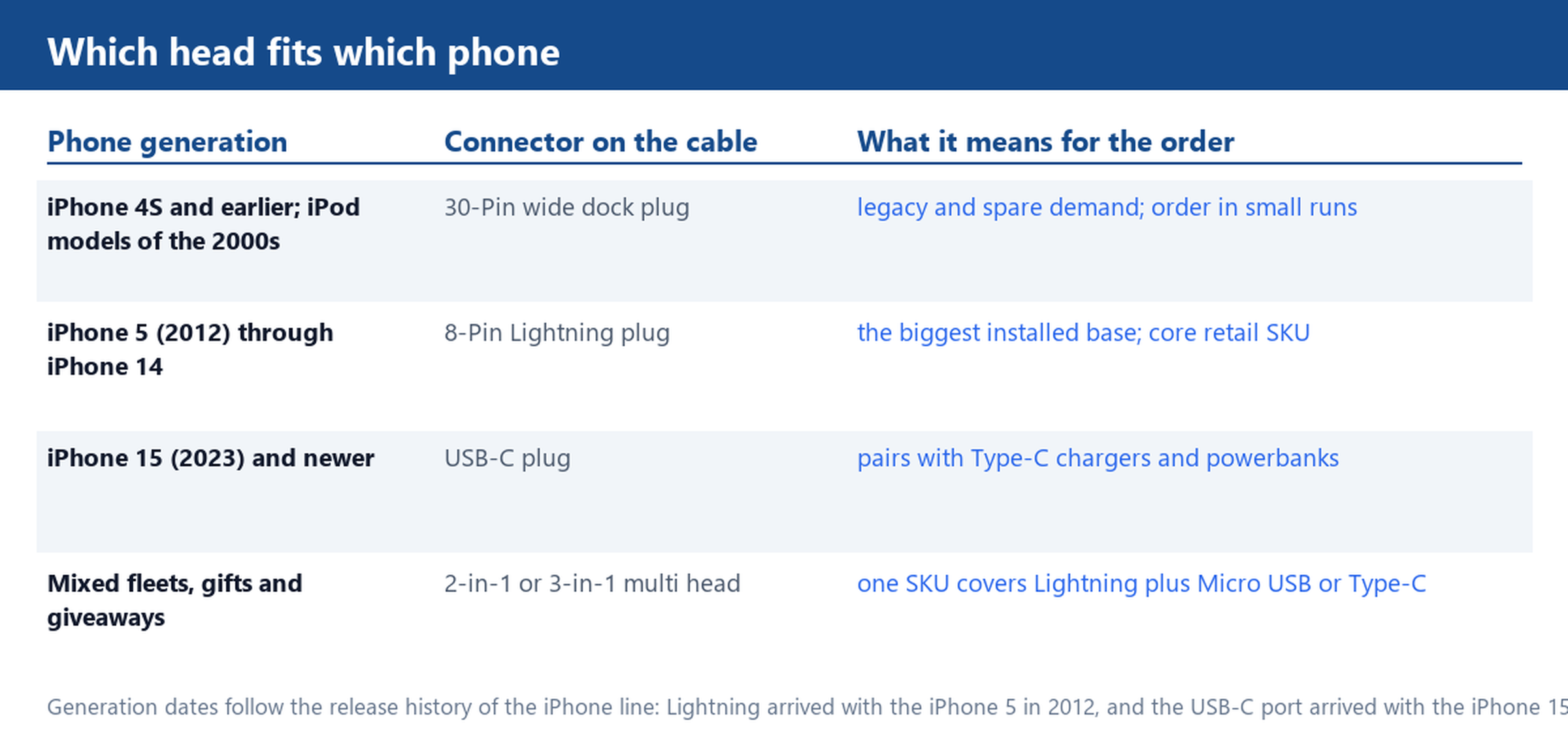
Match the Connector to the Phone Generation: 8-Pin, 30-Pin and the USB-C Transition
The iPhone line has used three charging connectors across its generations. The wide 30-Pin dock connector shipped on iPod models through the 2000s and on the iPhone through the iPhone 4S. The 8-Pin Lightning plug arrived in September 2012 with the iPhone 5 and stayed through the iPhone 14 generation. From the iPhone 15 onward, the phone charges over USB-C, the same oval plug used on current Android handsets, tablets and laptops.
For a resale order that breaks down into three demand pools. The 8-Pin pool is the deepest, because the iPhone 5 through iPhone 14 span more than a decade of handsets still in circulation. The USB-C pool grows with every new phone shipped, and a USB-C to Lightning lead is what connects those newer phones to chargers and powerbanks that already carry a Type-C port — see the USB-C to Lightning PD cable in the catalogue for that build pattern. The 30-Pin pool is small but real: legacy device users, spare-part counters and replacement buyers. Before you fix quantities, count the device generations your buyers actually carry; a market full of hand-me-down iPhone 8 and iPhone 11 units needs 8-Pin stock, not USB-C.
One Head or Two: 2-in-1 and 3-in-1 Builds for a Mixed Fleet
A single-head cable is the clean choice when the fleet is uniform. A mixed fleet — couples with one iPhone and one Android, gift bags, promo giveaways — is where multi-head builds earn their place. A 2-in-1 bracelet cable carries Micro USB and Lightning on one body, and a 3-in-1 TPE noodle cable adds Type-C, so one SKU covers the three plugs a mixed household actually owns. The Micro USB cables category shows how deep the Micro USB half of that pairing still runs.
The trade is current capacity and wear. The shared head carries the current for whichever plug is live, and the moving parts of a slider or dual-head design see more mechanical stress than a moulded single plug. For gift and lanyard items that trade is usually acceptable; for daily-driver charging, buyers tend to prefer dedicated single-head leads. A working rule: if more than a quarter of the target fleet is non-iPhone, quote a multi-head build; otherwise stay single-head and put the budget into jacket and strain relief. The iPhone USB cables category shows both patterns side by side.
Reading the Current Rating: 2A, 2.4A and What the Label Actually Means
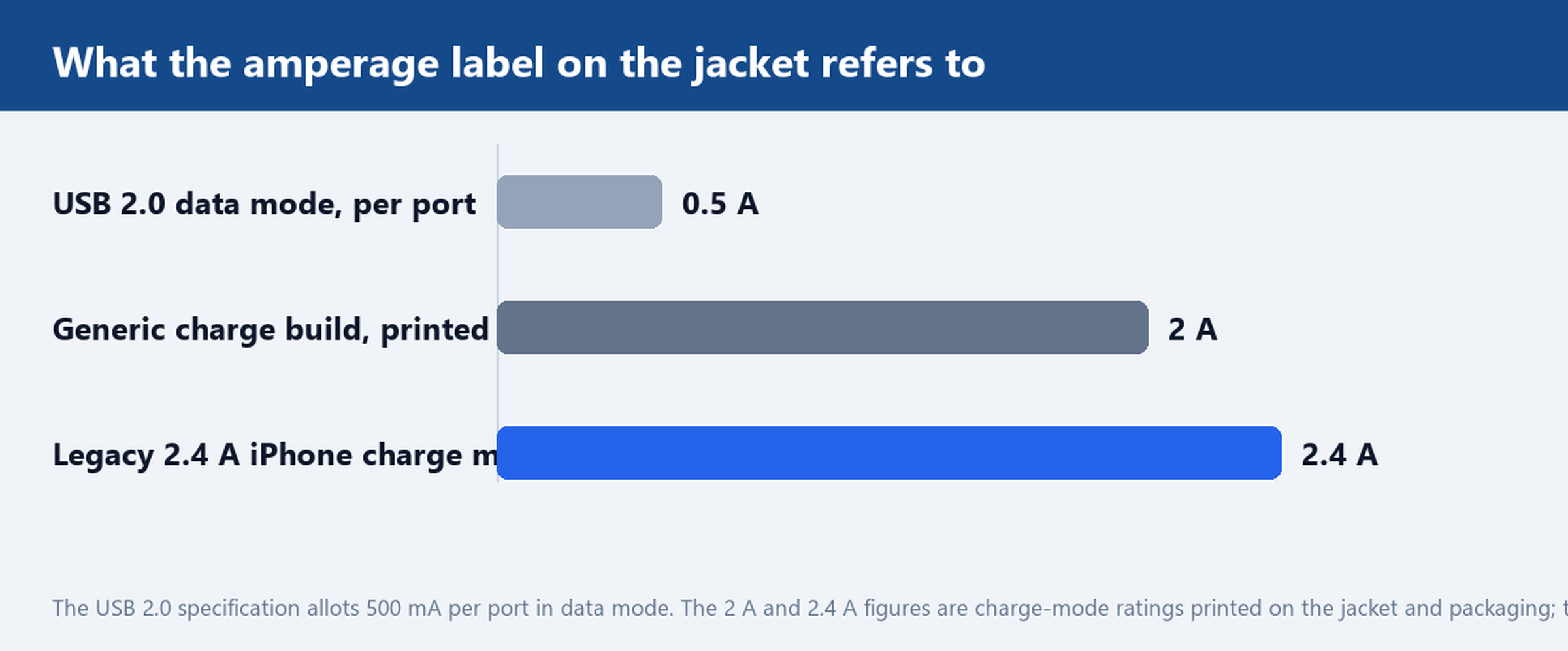
The amperage printed on a cable is the current the build is rated to carry, not the current the phone will draw. In data mode, the USB 2.0 specification allots 500 mA per port, which is why an old data-sync lead charges slowly even on a strong charger. Charge modes step past that: generic builds commonly print 2A, and 2.4A refers to the legacy 2.4A charging mode at 5 V that iPhones negotiated before USB-C power delivery took over.
Three checks keep this honest on an order. First, ask the supplier to state the copper gauge behind the printed number — a 2.4A print on thin conductors will run warm. Second, confirm the rating appears consistently on the jacket, the packaging and the carton, since retail buyers read the box. Third, verify on the sample: plug it into a USB power meter with a test phone at low battery and log the current you see. That logged number, not the print, is what your product listing can defend.
Stock Lengths: 20 cm Keychain Builds to 1.2 m and 1.5 m Desk Runs
Length is where a resale assortment is won or lost, and the factory stock range runs from 20 cm to 1.5 m. The short 20 cm builds suit powerbanks, car consoles and keychain or lanyard products, where a long tail of cable is a nuisance rather than a feature. The 1 m lead is the retail default and the natural first order. The 1.2 m length suits desk setups where the outlet sits behind the monitor arm, and the 1.5 m run reaches floor sockets and bedside walls. Every extra decimetre adds copper, so longer builds cost more per unit; anything past 1.5 m becomes a custom run rather than a stock item, and the customize cable page is the route for that.
MFi Paperwork and the Sample Charge Check Before the Bulk Order
If the order is meant to carry the MFi mark, the paperwork has to come before the deposit. MFi is a licensed program: ask the supplier for the licence documentation for the exact model, and check the paperwork rather than trusting a logo on the box. If the order does not require MFi, write that on the purchase order so both sides price and label the goods the same way.
Then run the sample routine. Log charge current with the power meter as above, feel the plug for wobble in the port, bend the strain relief through a working day of motion, and read the print on jacket and box under a lamp. The how to order page lays out the sample and production steps. Send the phone models your buyers actually carry and the length you need, and a 1 m 8-Pin sample ships so you can log charge current before the bulk order.