

If one question decides whether a 3.5mm stereo cable order works on the first plug-in, it is this: how many conductive rings sit on the plug? A three-conductor plug built for a headphone jack will not carry a microphone on a headset jack, and a four-conductor plug pushed into a three-conductor socket drops its ground on the wrong contact, which is exactly why one channel goes quiet or the plug sits loose in the port. Count the rings first, then settle the shield, the plug angle and the run length. This guide walks the decisions in the order a buyer should make them.
Three Poles or Four: What the Extra Ring Actually Carries
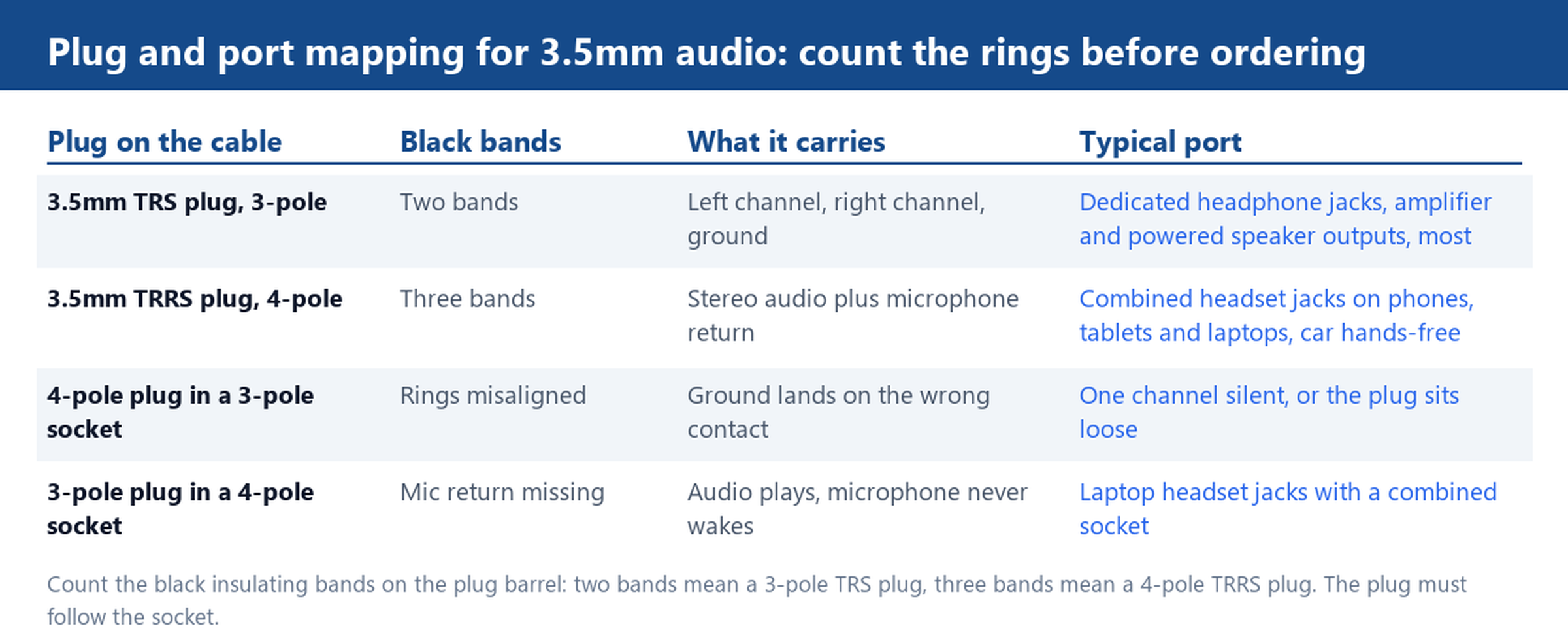
The three letters describe contact zones, not sound quality. TRS stands for tip, ring and sleeve: three metal segments separated by two black insulating bands. The tip carries the left channel, the ring carries the right channel, and the sleeve is the common ground. That is a complete stereo connection, and it is all a dedicated headphone output expects to see.
TRRS adds one more contact zone and one more black band. The fourth conductor carries the microphone signal back to the device, which is what a combined headset socket on a phone, tablet or laptop waits for. The CTIA layout, with the microphone contact on the sleeve and the ground on the second ring, is the default across current phones, tablets and laptops; the older OMTP layout swaps those two contacts and survives mainly in some older headsets. When a supplier states the pole count, ask for the layout as well, because a four-pole plug wired to the wrong layout will pass audio but mute the microphone.
The failure modes are consistent enough to diagnose from the symptom alone. One channel silent points to a four-pole plug sitting in a three-pole socket with the rings misaligned. Audio fine but the microphone dead points to a three-pole plug in a four-pole socket. Both are cable selection problems, not device faults, and both are free to avoid at the ordering stage.
Matching the Plug to the Port: Headphone Jack, Headset Jack and Splitter
Dedicated headphone jacks on amplifiers, powered speakers and most car head units expose three-pole sockets. Headset jacks on phones, tablets and laptops combine the speaker and microphone paths into a single four-pole socket. The plug must follow the socket, and the fastest check is the ring count described above.
Where a device keeps separate three-pole headphone and microphone sockets but the headset carries one four-pole plug, a TRRS splitter closes the gap: the 3.5mm splitter cable for PC and laptop in our catalogue takes a four-pole male and breaks it out to two three-pole females, one marked for the headphone and one for the microphone. For direct runs into headset sockets, the 4-pole TRRS nylon braided AUX cable carries stereo audio and the microphone channel in one lead, with gold-plated plugs on every length option.
Where Noise Enters a 3.5mm Run: Shield and Braid
A 3.5mm audio link is unbalanced: the two signal conductors ride above one shared ground, and the receiving end has no differential stage to cancel noise. The shield does all the work, which is why the conductor and shield build matters more on this connector than on almost any other consumer audio lead.
The car environment is the hard case. The wiring loom carries switching noise from the alternator and the ignition system, and an unshielded aux lead lying across it hums or whines along with the engine. Inside the double-shielded builds in our stereo line, tin-plated copper conductors sit in braid shielding with PE foam insulation between the layers, which keeps that hum out of the signal path.
Braid also carries the mechanical load. The braided four-pole line is specified at 10,000+ bend cycles, and the nylon jacket resists the abrasion of glove boxes and backpack pockets where a smooth PVC lead eventually turns white and cracks. Foil shield and oxygen-free copper appear across the category as well: foil blocks radio interference in thin builds, OFC lowers conductor loss on longer runs, and both sit in the 3.5mm stereo cable category so the choice follows the install rather than the shelf.
Right-Angle and Spring Plugs for Car Dashes and Pockets
Straight plugs fail at the point where the cable exits the barrel. A phone in a case, plugged into a dashboard AUX port, levers the straight plug against the case edge, and the conductors inside work-harden and open over time. Two catalogue builds answer that failure directly.
The 90-degree AUX cable with metal spring protector exits at 90 degrees with a spring at each plug and an aluminium alloy shell, so the bend happens in the spring instead of inside the plug. On the extension line, a step-down beveled plug slimmed below the full barrel diameter seats into ports partially covered by a phone case. Pick the shape from the mount: right angle for dashboards and any port close to a wall or a case edge, straight for open panels and home stereos.
Length: 1 m, 1.8 m, 3 m and What Changes at Each
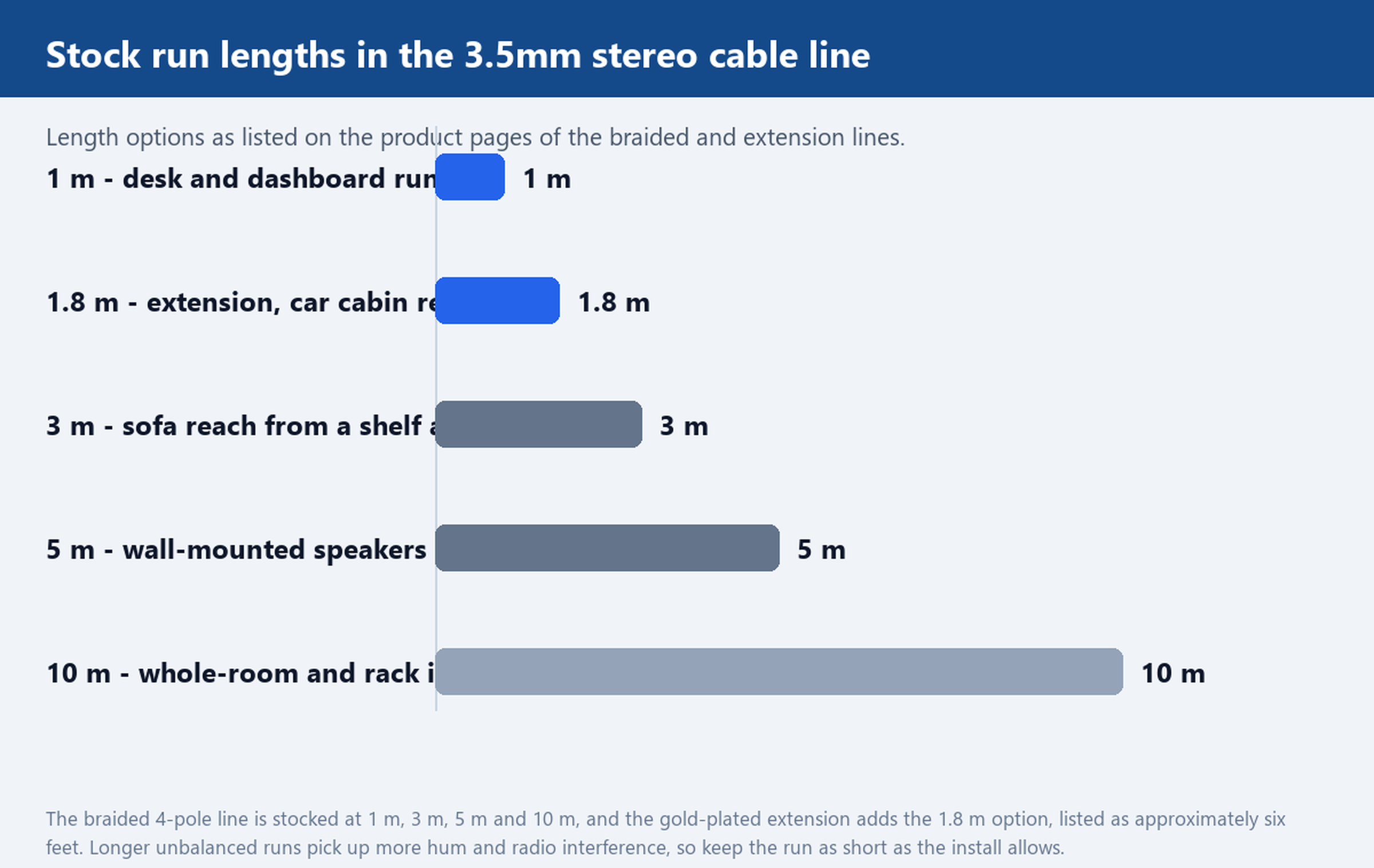
Length is a mechanical decision first and a signal decision second. At 1 m, a lead reaches a desk or a dashboard with no slack to tangle, and it is the sensible default for phone-to-speaker runs. The 1.8 m gold-plated AUX extension cable, listed at approximately six feet, is sized for car cabins: a phone on the seat or the dash reaches the head unit with slack for the door swing. At 3 m, a headphone reaches the sofa from a shelf amplifier. Beyond that, the braided four-pole line is stocked at 5 m and 10 m for wall-mounted speakers and rack installs.
On the signal side, an unbalanced run picks up noise roughly in proportion to its length, and ground resistance accumulates over the same distance. The practical rule is to buy the shortest length that reaches with a little slack, and to prefer a double-shielded build for anything over 3 m or routed near power wiring.
Send a Photo of the Jack and the Port, and We Confirm the Pole Count
Most mismatches in this category trace back to a plug that never matched the port. The fastest check costs nothing: photograph the plug you intend to use and the socket it must land in, and send both. We read the ring count and the socket marking, confirm the pole count and the layout, and quote the matching 3.5mm cable from stock, with a sample for fit testing before any production order.
Samples ship in 5 to 7 working days. Custom runs take length, jacket colour, braid pattern, plug angle and a moulded logo, and stock builds start from 100 pcs per model. The factory page shows the line that winds and tests these leads, the customization page lists the build options, and the ordering page sets out the quotation steps from inquiry to shipment.