

Two guitar cable runs on the same rig can sound completely different, and the fix is usually in the purchase order rather than in the amp. A 3 m lead from the guitar to the amplifier and a 15 cm patch between two pedals carry the same instrument-level signal, but they see different mechanical stress, different capacitance per metre and different plug clearances. Buyers sourcing instrument cable for a retail line, a rental fleet or an OEM bundle usually have to lock three things at once: conductor and shield, jacket and plug shell, and which lengths ship in the set. Get those three right and the returns drop, because most complaints trace back to a spec that was never written down.
Unbalanced Instrument Cable vs Balanced Line: Where the Noise Enters
A passive guitar pickup is an unbalanced source. The cable carries the signal on the centre conductor and uses the shield as the return path, which means the shield does two jobs at once: it drains interference and it completes the circuit. Any potential difference between the amplifier ground and the ground at the other end of that shield becomes audible as hum, because the shield is part of the audio path and not just a screen around it.
A balanced line works differently. Hot and cold conductors carry the same signal with opposite polarity, the shield is a screen and not a signal return, and the input stage subtracts the difference. Interference that arrives equally on both conductors cancels. That is why a stage box can run 20 m to a mixing desk without picking up the lighting dimmers, and it is also why swapping a humming guitar lead for a balanced cable does not fix the hum: the source at the guitar end is still unbalanced, so the run from guitar to first active stage stays unbalanced by design.
Diagnosing the noise is worth an hour before blaming the cable. With the guitar volume up and the amplifier gain at playing level, unplug the guitar and listen: hum that appears only when the cable is plugged into the amp and the free end touches nothing usually points to a shield or ground problem in the cable. Hum that changes when you touch the strings points to a ground reference issue between amp and PA, and hum that follows a lighting cue points to radiated interference. Only the first case is the supplier problem.
What a buyer writes on the order is the thing that prevents argument later: 6.35 mm TS plugs, two-conductor construction with a braided shield, stated coverage percentage, and the conductor gauge. Our guitar cable range is built to that pattern, and the balanced counterpart lives in the microphone and XLR cable section, so the two lines do not get mixed on a spec sheet.
Conductor and Shield: What 22AWG OFC and 99% Coverage Change
Gauge is the first number to pin down. 22 AWG is the common conductor size for instrument cable because it balances resistance against flexibility: a 3 m run at that gauge keeps series resistance low enough that pickup loading stays predictable, while the cable still coils flat and survives being walked on. Going up to 20 AWG lowers resistance further and slightly reduces high-frequency loss over long runs, but the cable becomes stiffer, heavier and harder to route around a pedal board. For runs under about 6 m the audible difference is small; for long stage runs it is worth the trade.
Oxygen-free copper is a metallurgy claim, not a sound claim. What it changes in practice is the behaviour at the ends, where moisture and sweat reach the exposed copper under the plug shell. Fewer oxide inclusions in the strand bundle means less chance of the green corrosion that creeps up the conductor and turns a working cable into an intermittent one. On a rental fleet that is a real cost line, because the failure shows up as crackle, not as a clean break.
Shield coverage is where the cheap and the durable versions diverge. A spiral or serve shield is fast to braid and inexpensive, but the coverage opens up when the cable is flexed and it provides less screening at radio frequencies. A braided shield at 99 percent coverage costs more per metre, holds its shape better under repeated flexing, and closes the gaps that let dimmer and radio interference in. If the order says only shielded, the factory is free to ship either, so write the coverage figure and the construction into the specification. Ask for the capacitance per metre at the same time: instrument cable capacitance forms a low-pass filter with the pickup inductance, so a high-capacitance cable on a long run rolls off treble before the amplifier ever sees it.
Jacket and Plug Shell: 7 mm Braid, Right-Angle TS and Pedal-Board Clearance
A 7 mm outer diameter braided jacket is the practical middle of the market. It fits the strain relief of a standard 6.35 mm plug, it takes a cable tie without crushing the shield, and it resists the abrasion that comes from being dragged across a stage floor. Thicker jackets exist, but they coil badly and they stress the plug boot at the entry point. Thinner jackets are lighter and cheaper and are the right choice for fixed installs where the cable never moves.
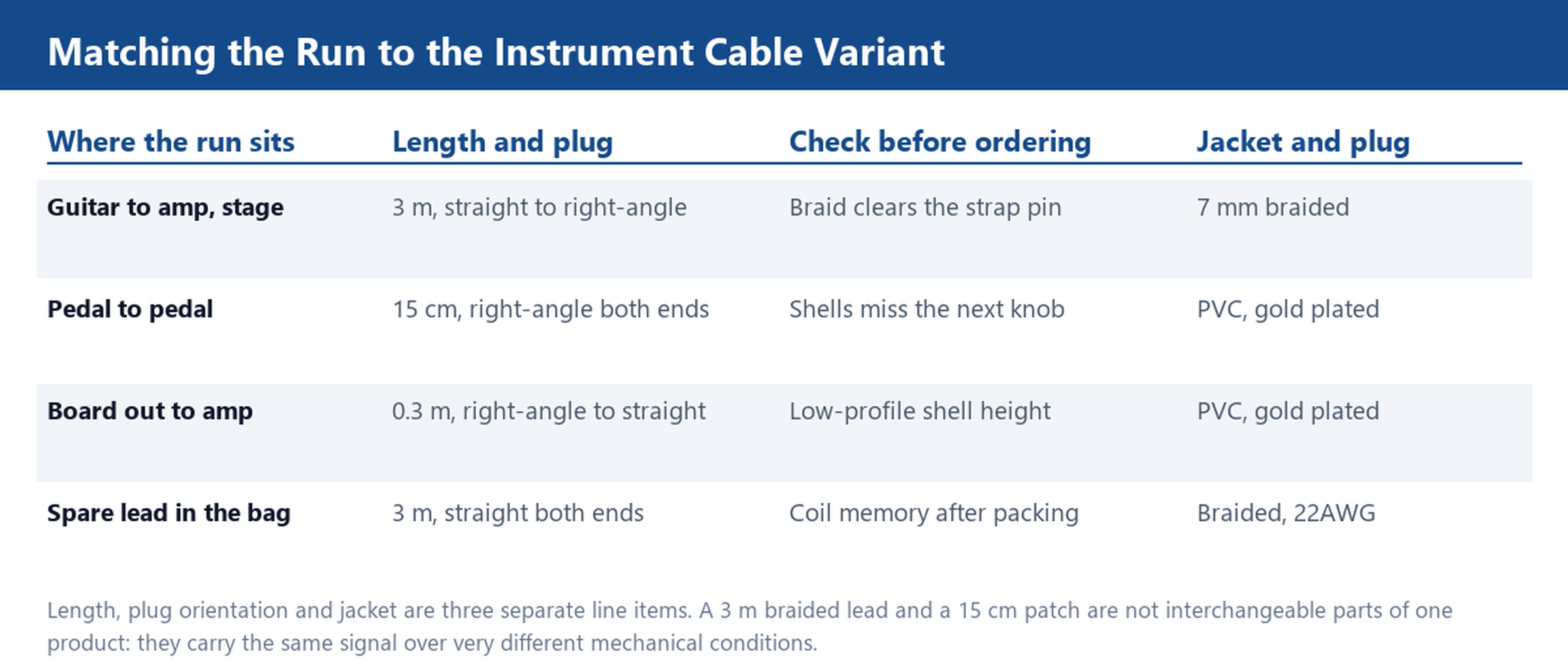
On a pedal board the plug shell is the part that fails first, and it fails mechanically. A right-angle plug puts the cable flat along the board, which protects the solder joints, but the shell body is what collides with the knob of the next pedal. This is why low-profile right-angle shells matter: measure the distance between the jack centres on the board, then check the shell length in the supplier drawing before ordering a patch length. A 15 cm patch with a tall shell can be unusable on a tightly packed board, while the same 15 cm with a low-profile shell fits.
Inside the shell, look for two details on the sample: whether the shield braid is dressed and soldered to the sleeve rather than twisted and clamped, and whether there is heat-shrink over the solder joints. Both are inexpensive at the factory and both are the difference between a cable that survives a year of load-ins and one that crackles after a month. Our braided guitar cable line uses the 7 mm jacket with a right-angle option, and the PVC guitar cable line covers the fixed-install and budget tiers where a lighter jacket is acceptable.
Length Choices That Matter: 3 m Stage Lead vs 15 cm and 0.3 m Patches
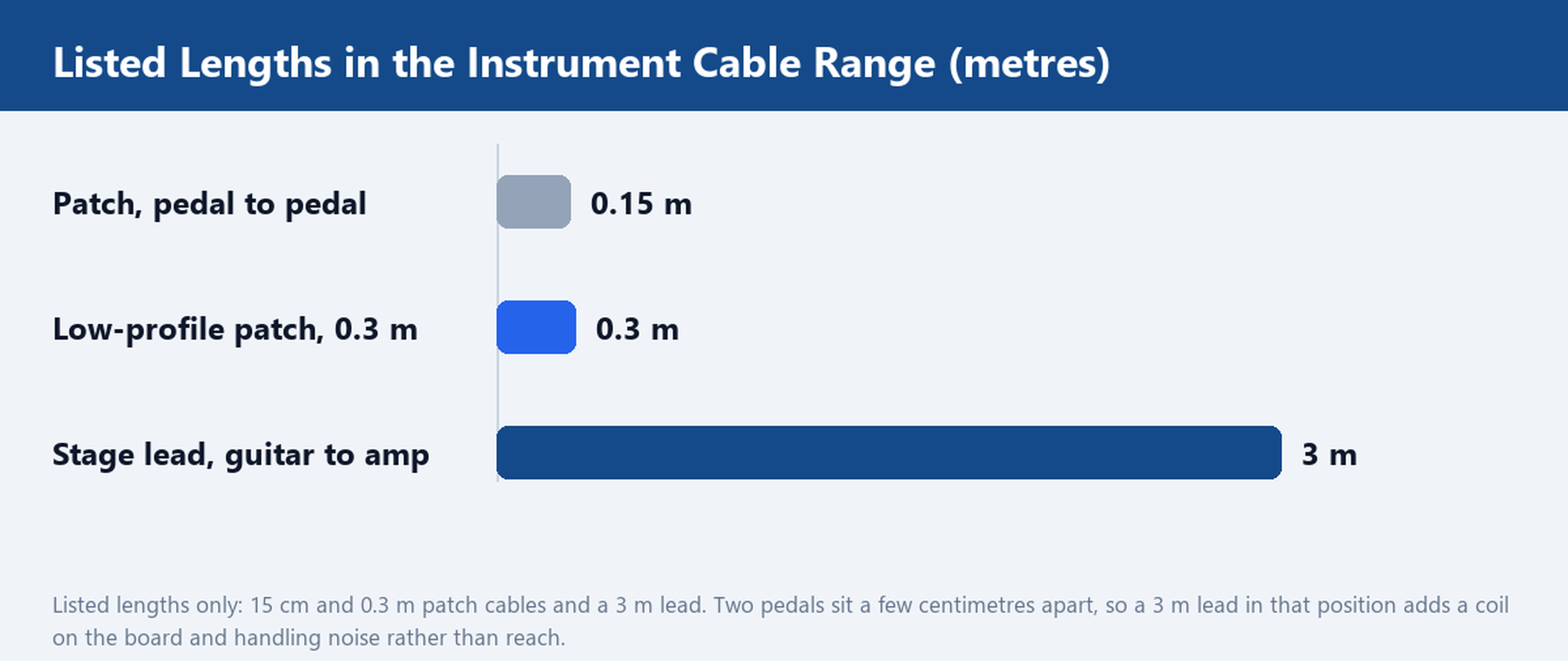
Length is not a free variable, because each length answers a different physical problem. Three metres covers guitar to amplifier on a small stage and leaves enough slack to step back from the mic without pulling the amp. Fifteen centimetres is the standard distance between two adjacent pedals on a board. Thirty centimetres covers the gap from the last pedal to the board edge, or the wider spacing around a pedal with top-mounted jacks.
The failure mode to design out is using one length for everything. A 3 m lead between two pedals leaves a coil sitting on the board, the coil picks up hum, and the weight of the coil pulls on the jack of the pedal underneath it. The reverse mistake is just as common: a 15 cm patch stretched from the board to the amplifier puts the plug under tension at both ends and cracks the solder joint at the tip.
Two lengths plus one patch length covers most rigs. In our range that maps to a 3 m lead such as the braided CTC9205 or the straight-to-right-angle CTC7927, a 15 cm patch such as CTC9217 supplied as a six-pack, and the low-profile 0.3 m CTC9153 for the board output. Keeping the count of lengths small keeps the carton labels simple and makes it obvious at a glance which cable belongs where. The effect board cable section groups the short lengths so they are not ordered by accident as stage leads.
Ordering a Mixed Set: Colour Coding, Multi-Packs and Carton Notes
Once a set contains more than two lengths, colour becomes a specification rather than a preference. Assign one colour per length, for example black for the 3 m stage lead, red for the 0.3 m board output and blue for the 15 cm patches, and print the length on the bag. On a dark stage, colour is faster to read than a label, and it stops a 15 cm patch being grabbed as a spare lead mid-set.
Multi-packs deserve their own line on the purchase order. A six-pack of 15 cm patches is a different SKU from a single patch, with its own carton, its own bag printing and its own barcode, and it is the format most pedal board buyers actually want. Singles of the 3 m lead stay individually bagged with the plug orientation printed on the bag, because a straight-to-right-angle lead and a straight-to-straight lead look identical inside a sealed bag.
Three notes belong on every carton: the plug orientation of each end, the jacket type, and whether the right-angle end is intended for the guitar side or the board side. That last point is the one buyers forget, and it is the one that generates returns, because a lead built with the right-angle end at the amplifier will not sit flat when the customer plugs it in the other way round. Ask for one bench sample set in the final braid and colour before the production run, plug it into a board with the real pedals, and check the shell clearance and the coil memory yourself.
Send us the stage length, the patch-board lengths and whether each end needs a straight or right-angle plug, and we will cut a sample set in the braid and colour you want for a bench test. Colours, bag printing and carton labels can be set per SKU on the customize cable page.