

A three metre USB 2.0 cable can still carry 2.4 A of charging current, but only if the copper inside is thick enough, and the answer hides in one line of the quotation: the conductor gauge. Length itself does not throttle charging. The power pair has a fixed resistance per metre, and every extra metre multiplies the loss. So how long can a USB 2.0 cable be? For data, the specification allows 5 m. For charging at 2.4 A, the working answer is: exactly as long as the AWG number on the quote permits. This guide works through the arithmetic at 1 m, 2 m and 3 m so the conductor spec can be checked before a sample is ever moulded.
What Changes as a USB 2.0 Cable Gets Longer
Two things scale with length and one does not. Data signalling does not fade gradually. USB 2.0 Hi-Speed runs at 480 Mbps with a defined signal-quality margin, and the specification allows a detachable cable up to 5 m. Inside that envelope the link either passes or it disconnects; there is no half-speed middle ground to fall back on. Power behaves the opposite way: voltage drop is continuous and cumulative, because current must travel out along the power conductor and return along the ground conductor.
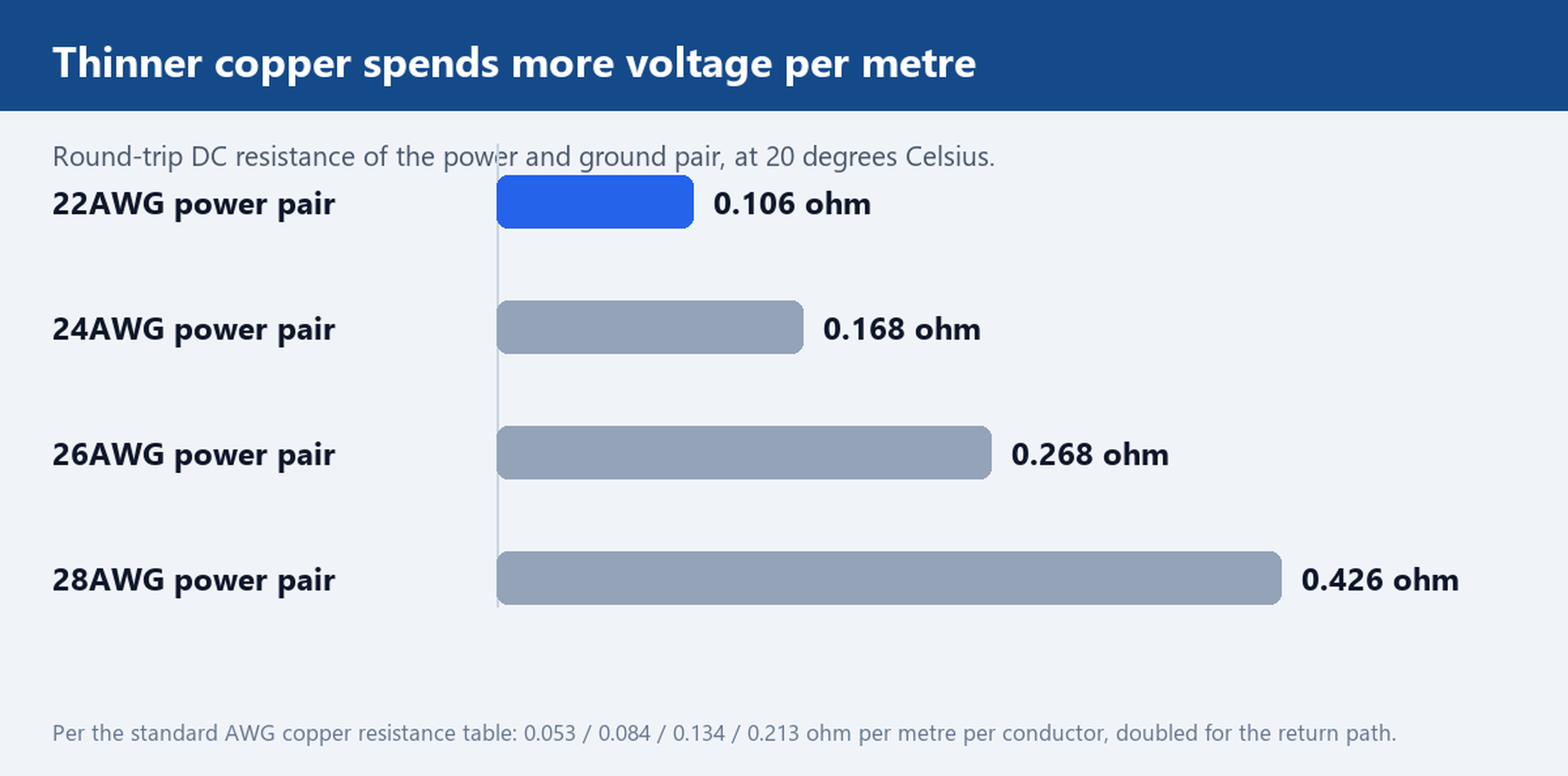
That round trip is the part buyers most often miss. A build using 22AWG copper presents about 0.053 ohm per metre on each conductor, so the power pair loops about 0.106 ohm per metre once the return path is counted. At 2.4 A that is roughly 0.25 V lost per metre, before connector contact resistance is added on top. Stretch the same build to 3 m and the loss triples. None of this is exotic; it is the same Ohm law that governs any wire, applied twice per cable.
22AWG vs 24-28AWG: Reading the Conductor Spec on a Quote
Cable quotations often hide the gauge in a single line such as conductor: 24AWG tinned copper, or omit it entirely. The AWG number describes the cross-section of each copper strand, and the standard AWG resistance table turns it into the loop numbers that matter:
- 22AWG: about 0.053 ohm per metre per conductor, about 0.106 ohm round trip
- 24AWG: about 0.084 ohm per metre, about 0.168 ohm round trip
- 26AWG: about 0.134 ohm per metre, about 0.268 ohm round trip
- 28AWG: about 0.213 ohm per metre, about 0.426 ohm round trip
Two samples can look identical in photos, braid and connector plating, and still differ by a factor of four in loop resistance if one hides 22AWG and the other 28AWG. Sync cables were sized for the 500 mA of the original USB 2.0 bus, which is why 28AWG power conductors are common in data-only builds. A charging cable that still carries 28AWG is a data cable in a charger costume, and the gap only appears under load. If a quotation does not state gauge, ask for the conductor diameter in millimetres and match it against the AWG table before comparing prices. Our USB 2.0 cables list the conductor build on the product page for exactly this reason.
What 2.4 A Charging Looks Like at 1 m, 2 m and 3 m
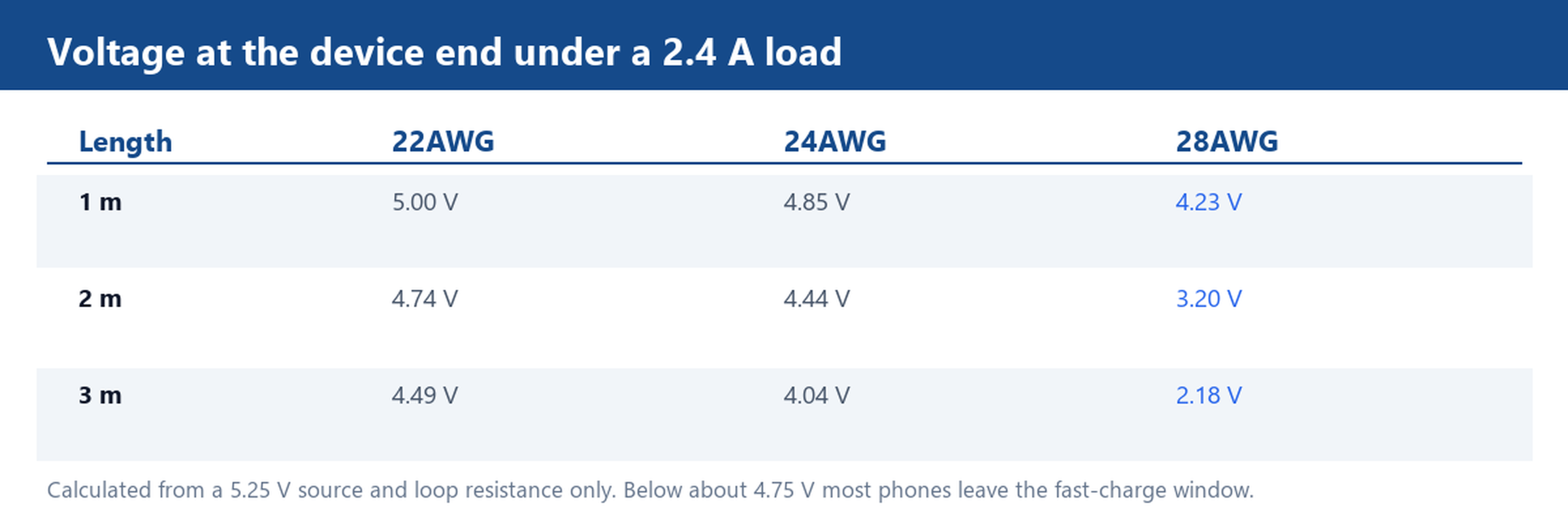
Start from a charger sitting at 5.25 V, the upper edge of the classic 5 V ±5 percent supply band, and draw 2.4 A through each build. Subtracting the loop drop per metre gives the voltage the device actually sees:
- 1 m: 22AWG holds about 5.00 V, 24AWG about 4.85 V, 28AWG about 4.23 V
- 2 m: 22AWG about 4.74 V, 24AWG about 4.44 V, 28AWG about 3.20 V
- 3 m: 22AWG about 4.49 V, 24AWG about 4.04 V, 28AWG about 2.18 V
Most phones treat roughly 4.75 V as the lower edge of the fast-charge window, which is the minus 5 percent side of the same band. Read the list against that floor and the picture is blunt. 22AWG clears the floor at every length shown. 24AWG clears it at 1 m, misses narrowly at 2 m and is clearly out at 3 m. 28AWG sits below the floor at every length, shedding about one volt per metre at 2.4 A. A tablet on a 3 m 28AWG lead may show a charging icon while the battery percentage barely moves; the port is alive, the copper is not.
Charging Current and Data Rate Hit Different Limits
Charger negotiation happens over the data lines at trivial current, which is why a cable can sync at 480 Mbps perfectly and still starve a device the moment high-current draw begins. The two limits live in different conductors: the data pair carries signalling, the power pair carries the load. That is also why the failure looks confusing in the field. The device shows a charging icon, the link never drops, and the visible symptom is slow charging that no bench test of the data side will ever reproduce.
The practical spec to write into a purchase order therefore splits the pair. A 24AWG or 28AWG data pair is fine for 480 Mbps inside the 5 m envelope. The power pair should be 22AWG wherever the build must hold 2.4 A at 2 m or more, and 24AWG is acceptable only on shorter runs or with chargers verified to sit near 5.25 V. This is the same split applied across the charger cables and Micro USB cables in the catalogue, and it is worth restating in the RFQ, because gauge is the one line a factory can thin without changing the appearance of the sample.
Length Limits to Accept Before Approving a Sample
Condensing the arithmetic into ceilings a buyer can defend in a meeting:
- 2.4 A at 3 m: specify 22AWG. 24AWG ends near 4.0 V, which is outside the window even with a generous charger.
- 2.4 A at 2 m: 22AWG is the safe pick; 24AWG is marginal and should be approved only after a load test with a meter at the device end.
- 2.4 A at 1 m: 24AWG passes; 28AWG still fails the 4.75 V floor and should be reserved for 500 mA sync duty.
- Data-only runs: up to 5 m per the USB 2.0 specification, with the usual advice to prototype at the real installation length rather than a catalogue length.
Then close with one verification step: load the sample at its rated current and measure at the device end, not at the charger. A factory confident in the conductor build will send a load-test report alongside the sample. If a custom length is planned for a kiosk, vehicle or desk installation, the Customize Cable page explains the gauge and jacket options, and the How to order page walks through quotation and sampling. Tell us the length and the current you must hold at the far end, and we will send the matching conductor build sheet with a free sample in your target length to load-test.