

One adapter covers one socket family, not a whole bike range. That is the first thing to settle before quoting a workshop bench. A road bike imported last season may carry a 4-pin sealed barrel, a dirt bike may carry a 6-pin plug, and a tourer from twenty years ago may carry a 10-pin round connector. None of them is the 16-pin J1962 socket that a car uses, and none of them will accept the standard motorcycle obd2 cable that ships with a generic scan tool. The workable approach is to buy adapters by contact count and housing, then let one 16-pin bench lead serve all of them.
Why a Bike Diagnostic Socket Is Not a Car Socket
A car sold in most markets after the early 2000s carries the 16-pin J1962 socket in a fixed place under the dash, with pin 4 and pin 5 as ground, pin 16 as battery positive and the serial lines on fixed contacts. A motorcycle kept its own connector because the socket has to survive rain, vibration and a wash-down, and because a bike loom is far smaller than a car loom. The result is a group of sealed round plugs that differ in contact count, locking collar and pin assignment.
Three things decide whether an adapter is correct, and none of them is the plug colour:
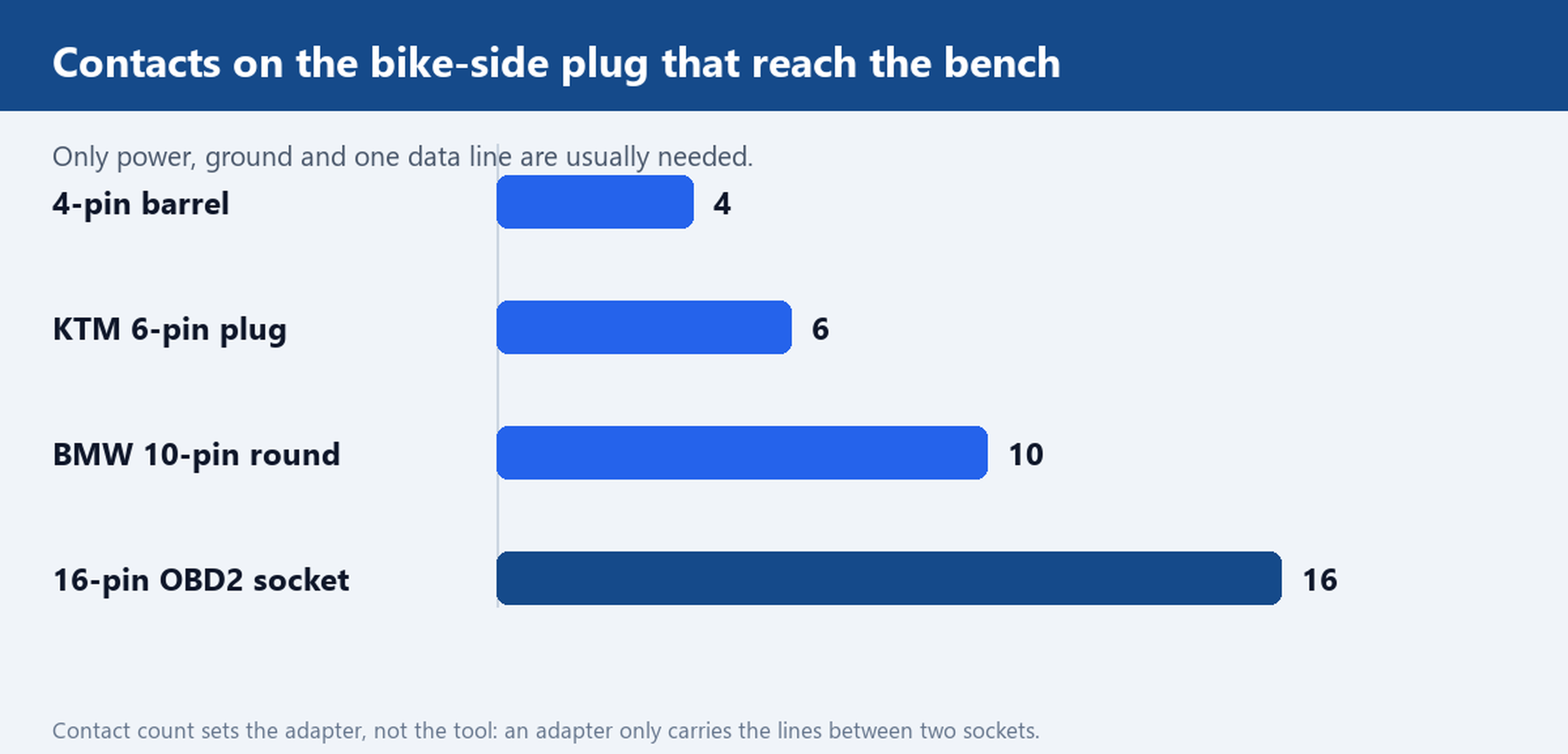
- Contact count. Count the pins inside the bike-side plug. A 4-pin plug cannot carry the same lines as a 10-pin plug, and an adapter cannot invent contacts that the socket does not have.
- Which contact is battery positive. On every one of these plugs one contact is switched or permanent 12 V. Wiring the adapter without confirming it risks feeding the scan tool backwards.
- Which contact is the serial data line. Usually one line, sometimes two. This is the contact that has to land on pin 7 of the 16-pin end for a K-line style tool to see the ECU.
Everything else on the plug is either a second data line the tool may not read, or a contact the bike does not populate. The OBD2 pinout reference on this site lists the 16-pin end contact by contact, which is the half of the mapping that is standardised.
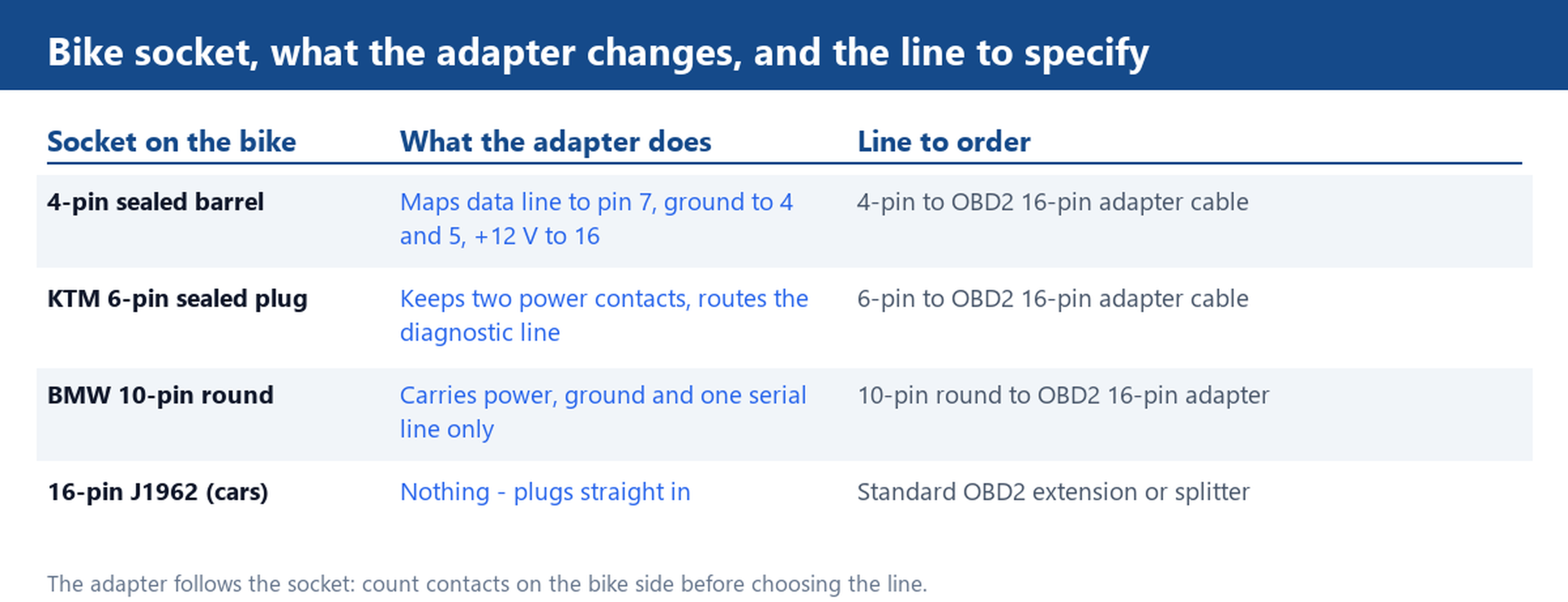
4-Pin, KTM 6-Pin and BMW 10-Pin Round: What Each Adapter Actually Changes
The three families below cover most of the mixed traffic a workshop sees. Each adapter is short, passive and specific, and each one changes only the wiring between two sockets.
4-pin sealed barrel. A small round plug with four contacts behind a rubber seal. In practice it carries battery positive, ground and one serial data line, which makes it the simplest of the three to adapt. The adapter maps that data line to pin 7 of the 16-pin end, ties ground to pins 4 and 5, and brings positive to pin 16. Because there are only four contacts, there is no ambiguity to resolve and no spare line to leave open.
KTM 6-pin plug. Six contacts in a compact sealed housing, used on a large part of the off-road range. Two contacts are power and ground and the diagnostic line sits on one of the remaining four. The adapter keeps the two power contacts where they are and routes the diagnostic line to pin 7. Buyers sometimes ask for a 6-pin adapter to also carry a second data line; that only works if the bike actually populates the contact, so confirm against the model before ordering a two-line version.
BMW 10-pin round. The oldest of the three, from the era before the 16-pin socket existed. Ten contacts, a screw-type locking collar and a housing large enough to survive a decade of heat cycles. The adapter carries power, ground and a single serial line and leaves the other seven contacts open. A 10-pin plug does not mean ten usable signals, and an adapter that pretends otherwise is a liability on a bench.
The practical rule for the parts counter: identify the socket by contact count and collar, write both on the order, and never substitute one family for another because the plug diameter looks close.
Passive Adapters Route Pins, Not Protocols: What the Scan Tool Must Already Cover
An adapter is wire, contacts and a moulded body. It cannot translate a protocol, buffer a signal or add a CAN controller. If the bike speaks K-line and the tool only speaks CAN, a correct adapter still produces no data. That is the single most common reason a bench blames the cable for a problem that sits in the tool.
Two checks before quoting:
- Read the tool support list by model and year, not by brand. A tool that lists a model year for K-line coverage is telling you it has the older transceiver inside. A tool that only lists CAN coverage will not answer on a 4-pin or 10-pin bike no matter which adapter is fitted.
- Confirm the data contact the tool expects. Most K-line tools expect the line on pin 7 of the 16-pin end. Some expect it on pin 15 or on both. If the adapter maps to pin 7 and the tool reads pin 15, the connection is electrically sound and functionally silent.
Voltage is the second half of the same question. A bike system is nominally 12 V, but the charging circuit sits above that while the engine runs, and a tool rated only for a bench supply will not enjoy a running engine. Specify adapter contacts and cable jacket for the current the tool draws, and keep the adapter short so the voltage drop stays where the tool can tolerate it. The open-end pin assignment page is the reference to hand to a technician who is re-pinning a cable rather than buying one.
Working Temperature Range and Bench Handling
A bike adapter is rated for a working range of -30 C to +80 C. That range is not decoration: it describes the two failure modes a workshop actually meets. At the cold end the jacket stiffens, and a cable that was coiled tightly in an unheated van will crack at the strain relief rather than at the plug. At the hot end the connector body softens, and an adapter left resting against an exhaust or a cylinder head will deform enough that the contacts no longer seat.
Handling rules that cost nothing and save adapters:
- Pull on the plug body, not on the cable, and never on the moulded joint.
- Keep the dust cap on the bike-side plug when it is not in use. A sealed housing only seals while it is closed.
- Label every adapter with its contact count and its data pin. A bench with six similar black plugs and no labels loses more time than a bench with three labelled ones.
- Coil at a diameter the jacket tolerates, and hang rather than fold.
Building a Mixed Adapter Set for a Workshop Bench
Stock by socket family, not by bike brand. Count how many bikes of each socket family come through a season, then hold two working adapters per family plus one spare. The spare matters because the failure mode is a single bent contact, and a bench that stops on one bent contact loses a booking.
The rest of the set is standard across families and worth buying once:
- One 16-pin 1-to-3 splitter so a second tool or a power feed can share the bench end without unplugging the first.
- A pinout card in the drawer for the 16-pin end and for each bike-side family, printed rather than remembered.
- A short extension in the 16-pin section, so the adapter sits away from the tank and the exhaust while the tool stays on the bench.
Where volumes justify it, a custom assembly is cheaper than a drawer of adapters that nearly fit. The custom cable page covers the options on housing, contact plating and length, and the OBD2 adapter cable range lists the vehicle-specific assemblies already tooled, including the 20-pin to 16-pin adapter used on older Asian cars. Both sit under the same OBD2 cable category as the bike adapters, which makes a mixed set one purchase order rather than four.
Send your bike model list for the season and we will confirm which adapters cover it, then quote a mixed set.